

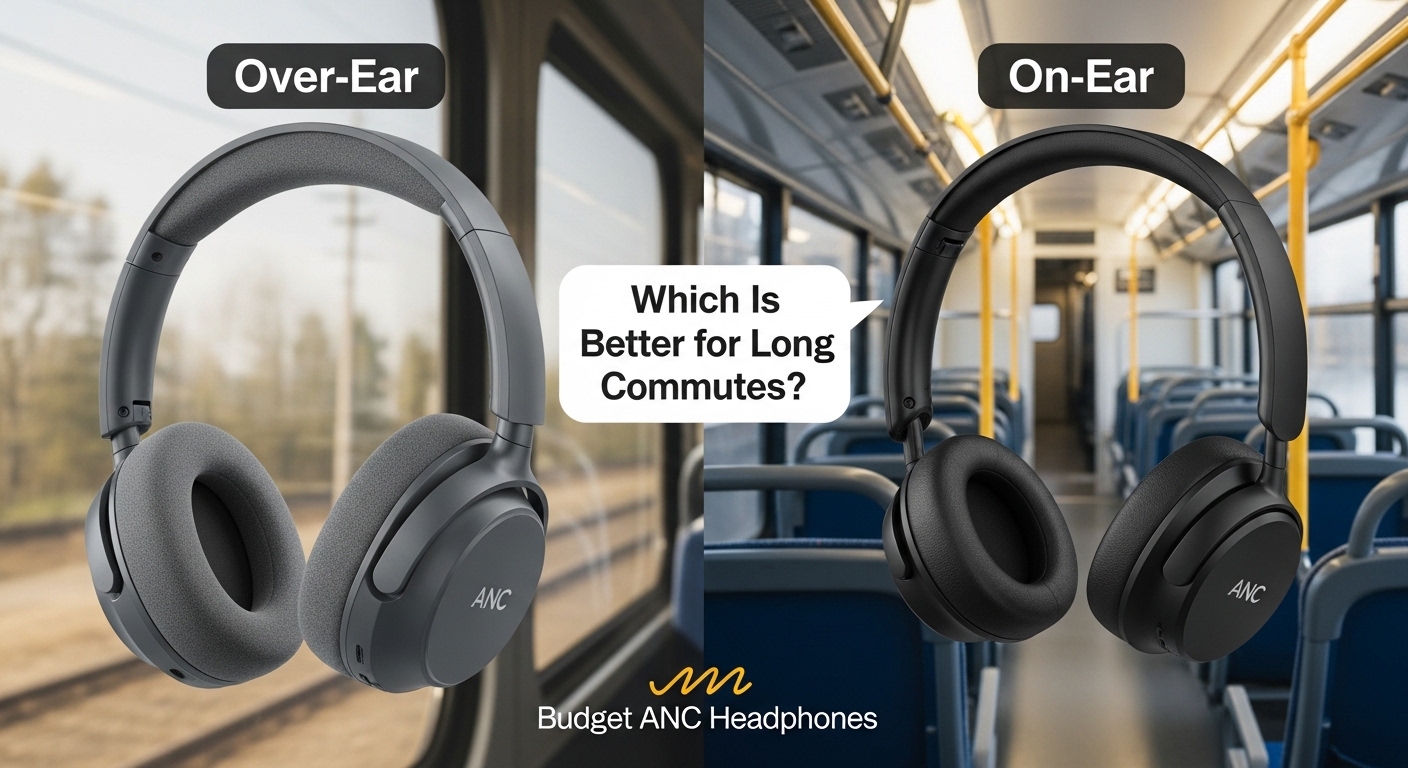
You’re trying to decide between over-ear and on-ear budget active noise-cancelling (ANC) headphones for your daily commute, and you want clear, practical advice that doesn’t rely on hype or brand names. This article walks you through the real differences that matter on long journeys: comfort, passive isolation, ANC effectiveness, battery life, call quality, portability, and long‑term reliability. You’ll learn how each form factor performs on buses, trains, and airplanes, which trade-offs are unavoidable at budget prices, and how to prioritize features based on how you commute and what you listen to.
By the time you finish reading, you’ll have a sensible checklist you can use when comparing inexpensive ANC headphones in-store or online, and you’ll better understand where budget ANC works well — and where it won’t meet your expectations.
Core Explanation / Problem
At the most basic level, over-ear and on-ear headphones differ in how they interact with your head and ears. Over-ear (circumaural) cups surround your ears and attempt to create a full seal around them. On-ear (supra-aural) pads sit on top of your ears and rely more on clamp force and the pad surface to attenuate outside sound. That physical interaction with your ear is the single most important factor for both passive isolation and how effective ANC will be. If you don’t get a good seal or stable position, the ANC system has less to work with and performance suffers.
Form factor also dictates weight, packability, and how heat builds up during a long commute. Over-ear models typically provide better passive isolation and room for larger drivers, which can mean fuller sound at low prices. On-ear models are often lighter and fold smaller, but they can leak sound more and rely more heavily on the ANC electronics to make up for weaker passive isolation.
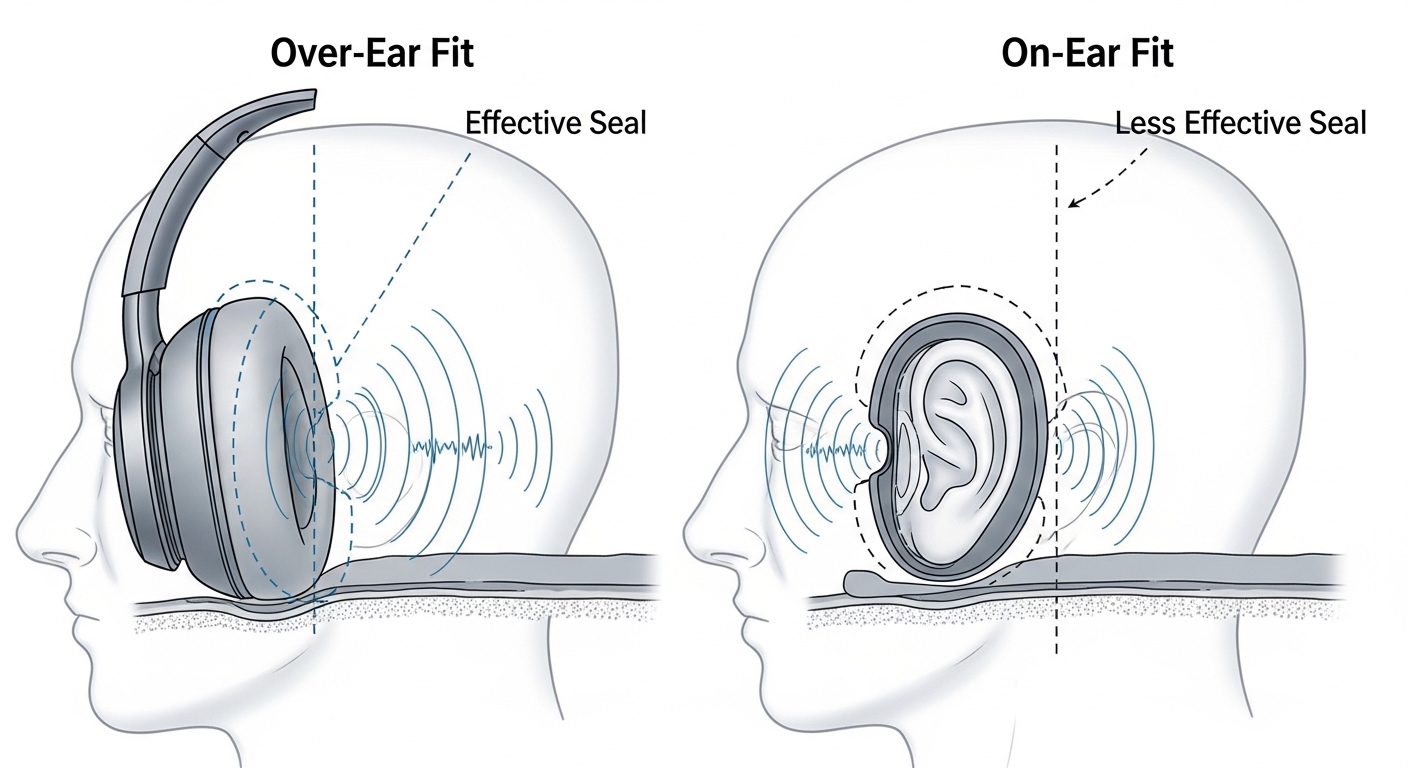
There are trade-offs in every budget ANC design. You’ll commonly see weaker microphones, simpler ANC algorithms, and less refined acoustic tuning compared with higher-end models. Hardware choices like microphone count, microphone placement, and battery capacity are often constrained to hit a lower price point. Expect compromises: ANC that performs well on steady low-frequency noise (like train rumble) but struggles with mid-frequency chatter or sudden high-frequency sounds, or headphones that warm your ears but don’t fully block ambient noise.
Micro Component / Key Details
When you peel back the exterior, several small components and design choices determine how well a budget ANC headphone actually performs for commuting. Below are the technical areas to pay attention to and how they influence your daily experience.
Microphones: How placement affects performance
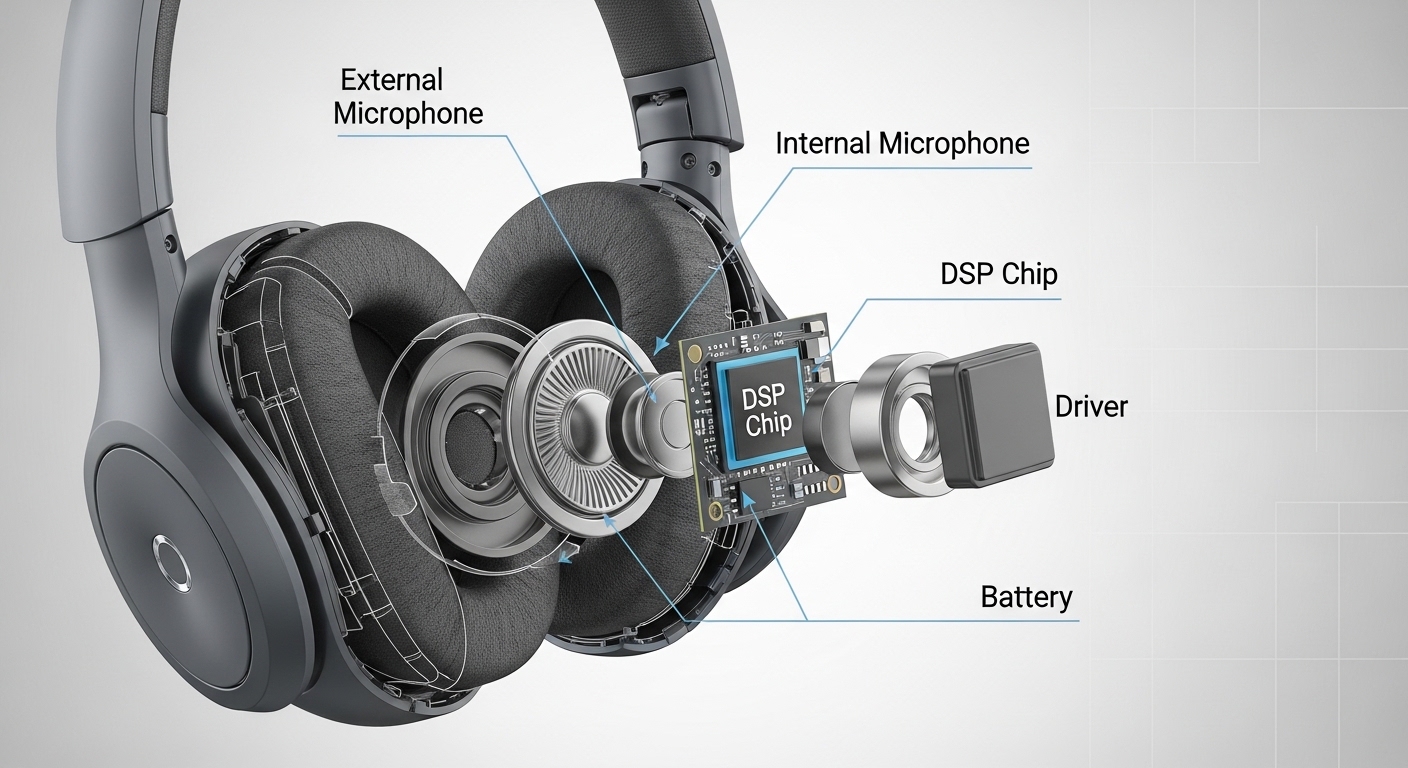
Microphones are the ears of the ANC system. Most ANC topologies use combinations of external (feed-forward), internal (feedback), or both (hybrid) microphones. External mics listen to ambient noise and let the processor generate anti-noise before it reaches your ear, while internal mics monitor what’s actually getting into the earcup and correct remaining errors.
On-budget headphones often use fewer mics and simpler placements to cut costs. If the external mic is poorly positioned — for example, tucked under a flimsy plastic grille or too close to the cup’s edge — it will capture a biased representation of ambient sound and the ANC correction becomes less effective. For long commutes, feed-forward microphones are particularly useful for steady background noise like vehicle engines, but they can falter with wind and sudden sounds if the capsule isn’t well-shielded or if the DSP isn’t tuned for those situations. Internal mics help preserve clarity for calls and music by monitoring the actual acoustic output, but if the ear seal is inconsistent (common on on-ear designs), internal mic corrections can be misled.
DSP, latency, and filters
The digital signal processor (DSP) is the brain of ANC. It analyzes microphone signals, inverts noise, and applies filters to avoid introducing unpleasant artifacts. At budget prices, manufacturers typically use simpler DSP chips with fixed-filter sets and less sophisticated adaptive behavior. That can mean:
- ANC that’s tuned mostly for low-frequency attenuation and offers minimal mid-frequency suppression.
- A higher chance of audible artifacts such as hissing, pumping, or a slight “underwater” sound on certain tracks.
- Limited adaptability to changing noise environments (e.g., boarding a bus, then moving to a noisy street).
Latency in ANC isn’t usually a problem for music listening, but if you’re making voice or video calls, or using audio-visual content with tight lip-sync requirements, DSP choices and Bluetooth codecs can introduce delays that harm the experience. Budget headphones often default to standard SBC or AAC codecs with modest latency, and you shouldn’t expect low-latency performance comparable to premium models.
Drivers and acoustic design
Driver size and housing design affect sound quality and how ANC interacts with the audio signal. Over-ear models can accommodate larger drivers and more internal volume, which often yields better perceived bass and a more spacious sound. On-ear drivers are constrained, and the closeness to your ear changes frequency response and imaging.
Acoustic tuning in budget gear is typically less refined, meaning bass can be boomy, mids can be recessed, and treble may be peaky. When ANC is engaged, the DSP usually reduces low-frequency noise but can alter perceived bass response; some cheaper ANC implementations create a sense of “thicker” low-end that isn’t entirely accurate to the source but can make music sound fuller on a noisy commute. If you favor clarity for podcasts and voice, look for balanced tuning or a companion app that offers EQ controls.
Battery and power constraints
Battery life is a practical constraint on any commute-focused headphone. Over-ear headphones generally have larger battery capacity due to more internal space, so you often get greater runtime. On-ear models sacrifice space for a smaller footprint and may clock in with shorter battery life. Fast-charging features are common even in budget models, but note that charging speed and power efficiency vary. If you regularly have long commutes or several short trips a day, prioritize models that promise conservative real-world runtimes rather than marketing numbers measured without ANC on or at low volume.
Real-World Experience / Practical Insight
Theory is useful, but your commute is where these devices are tested. Here’s how you’ll notice differences between over-ear and on-ear budget ANC headphones during daily use.
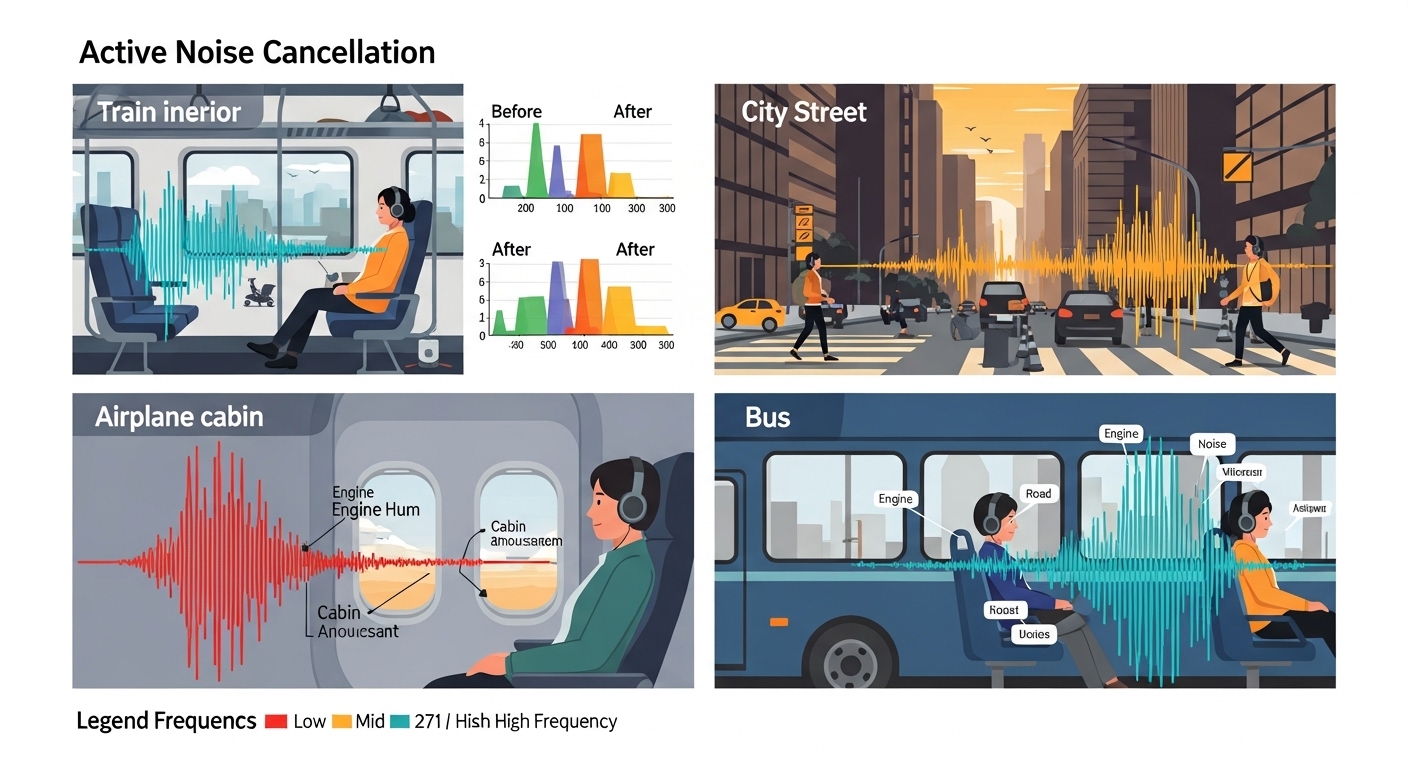
On trains and buses, low-frequency rumble and engine noise are common. Over-ear headphones typically outperform on-ear ones here because of better passive isolation — the earcup seals around your ear and physically blocks a lot of the noise before the ANC even starts. The ANC then needs to cancel less energy, which tends to reduce artifacts and improve battery efficiency. With on-ear models, the ANC has to work harder because the passive isolation is weaker, and you may perceive a faint hiss or pumping as the system tries to compensate for leaks around the ear pad.
City walking introduces high-frequency noises — sirens, voices, doors slamming — and transient sounds that challenge ANC systems. Neither over-ear nor on-ear budget ANC is perfect in these scenarios. Over-ears might still give you a sense of quiet thanks to better sealing, but you will still hear and sometimes feel sudden sounds. On-ear models may make ambient voices less intelligible but won’t block them as completely, which might be safer if you need to remain aware of your surroundings while commuting on foot.
Air travel presents a mixed bag. The steady low-frequency drone of engines is usually handled fairly well by both form factors if the ANC implementation focuses on low-frequency attenuation, but long flights can expose comfort and heat issues. Over-ear pads can become warm and slightly uncomfortable after hours, especially if the padding is thin or the earcups press tightly. On-ear models will keep you cooler but can become painful on the tops of your ears over long durations because pressure is concentrated over a smaller area.
When you make calls, microphone placement and wind rejection matter. Over-ear designs often offer slightly better microphone isolation from wind because the earcup body acts as a wind break, but it’s not guaranteed. If you regularly take calls during your commute, prioritize models reviewed for clear voice pickup rather than relying on ANC claims alone.
Software updates can meaningfully change performance over time. Budget manufacturers increasingly push firmware updates that tweak ANC algorithms, improve call processing, or refine EQ curves. You’ll get more value if the company maintains an app and firmware update pathway. Also expect performance to change with wear: cushion compression, hinge loosening, and grille blockage may degrade sealing and microphone function. Regularly inspect pads and replace them if they flatten out; small hardware maintenance can have a surprisingly big impact on ANC reliability.
Common Mistakes / Misunderstandings
People often have unrealistic expectations about budget ANC. Below are typical misunderstandings to avoid, followed by practical clarifications.
- Expecting ANC to replace passive isolation totally.
- Believing that a higher price bracket always means better ANC performance in budget models.
- Ignoring battery drain from ANC and call usage.
- Assuming on-ear designs are automatically better for commuting because they’re smaller.
- Overlooking fit and long-term comfort when judging first impressions.
Many buyers think ANC will turn noisy commutes into complete silence. In reality, ANC handles continuous low-frequency noise best — it’s less effective for mid- to high-frequency sounds and sudden transients. You should expect reduced rumble and more comfortable listening volumes, but not perfect quiet.
Price is another trap. While higher cost sometimes correlates with improved components and tuning, in the budget segment you can see big variability. Two similarly priced models might prioritize different things: one gives you better battery and call quality, the other better passive isolation and bass. Read spec sheets with a practical lens and focus on what matters to your commute.
Battery drain is underestimated. ANC, especially with high volume and frequent call use, significantly reduces run time compared to passive listening. If you forget to charge overnight, you can be left with headphones that behave like ordinary Bluetooth cans until you plug them in. Consider how often you can charge and whether the device supports quick top-ups.
Finally, fit and comfort are often judged in a store at a five-minute test. Long commutes are much longer than store trials; pressure, heat, and ear fatigue are cumulative. Don’t ignore pad material, clamping force, and headband design just because the product looks compact or trendy.
Evaluation / Authority Block
To assess ANC performance objectively and fairly, you need to look at measurable and experiential factors. The most reliable objective metrics are frequency attenuation curves (what frequencies are reduced and by how much), A-weighted dB reduction in common commuting environments, and latency measurements when ANC or Bluetooth layers are engaged. Practical measures like battery runtime with ANC on, charge time, and microphone SNR (signal-to-noise ratio) for calls also matter.
You can evaluate these aspects at home or using simple tests in the store. For attenuation, listen to a typical commuter noise source: a smartphone recording of a train or bus on repeat. Measure how loud you need to set your music to achieve comfortable listening. For the battery, consider real usage: enable ANC, set your usual volume, make a few short calls, and track how many hours you get. For microphone and call clarity, record a short call in a noisy environment (real or simulated) and listen back on headphones or loudspeakers — recordings reveal more than subjective impressions during a live call.
From a reviewer’s authority standpoint, prioritize the combination of objective and subjective tests. Objective measurements tell you what the hardware and algorithms are doing; subjective listening tests tell you if those numbers translate into a better commuting experience. As someone focused on budget audio gear, you should expect incremental improvements across product generations rather than revolutionary differences at a given price point. An ANC system that consistently reduces 18–22 dB in the 50–200 Hz band while keeping midrange clarity intact will provide a noticeably calmer commute.
Practical advice: when you can’t test gear yourself, read multiple sources and look for consistency in reported weaknesses (for example, repeated mentions of a distracting hiss or poor build quality). Seek models that provide firmware updates and have active support, because the software side often improves ANC performance post-launch.
Who This Is (and Isn’t) For
If you primarily commute on trains, subways, or buses with lots of low-frequency noise and you value long periods of uninterrupted listening, over-ear budget ANC headphones are likely the better choice. You’ll get superior passive isolation and a more relaxed listening environment for the same ANC hardware. Over-ear options also typically offer more comfortable long-wear experiences if they have sufficient padding and a well-designed headband.
If your commute involves walking through busy city streets where situational awareness matters — or if you frequently switch between on-the-go and office carry where compactness is a priority — on-ear ANC models might make sense. They’re lighter, easier to stow, and can be less warm over short trips. However, they trade off some isolation and may produce more ANC artifacts if the fit shifts as you move.
If the budget is tight, think about your priorities. You can often buy on-ear headphones that look appealing and save a bit of money, but you might regret the weaker isolation during noisy commutes. Conversely, rarely do budget over-ear models offer both exceptional ANC and exceptional long-term comfort — expect to choose the feature set you value most rather than expecting an all-rounder.
Consider these commuting scenarios to determine fit:
- Long intercity trains (2+ hours): Over-ear with a reliable battery and comfortable cushions.
- Short urban transit hops (30–45 minutes, multiple changes): Either form factor, but prioritize ease of carrying and quick comfort.
- Walking in traffic-heavy areas: On-ear or in-ear ANC (if available), if you need to retain some awareness; otherwise, a conservative over-ear with transparency mode might be safer.
- Combined work/call use: Over-ear with a tested mic setup and decent app support for firmware.
Budget considerations: If you can slightly stretch your budget for a model with known firmware updates, a robust app, and replaceable ear pads, you’ll likely have a better long-term experience than choosing a model with flashy specs but poor aftercare.
Practical Buying Checklist for Long Commutes
When you’re comparing budget ANC headphones, use this short checklist to separate realistic options from marketing claims. Each item here is tied to a practical commuting outcome.
- Comfort over time: check clamp force, headband padding, and ear pad material for breathability.
- Realistic battery life: confirm run time with ANC on and typical volume; prioritize faster charging if you’re often between charges.
- Microphone and call testing: find user or reviewer recordings for real-world call performance.
- Passive isolation: prefer over-ear designs if your commute has heavy low-frequency noise.
- Firmware/app support: look for devices where the manufacturer provides updates and basic EQ control.
- Portability: if you need to carry the headphones folded in a bag or case, check the folding mechanisms and overall footprint.
Use these criteria as filters rather than absolute deal-breakers. In the budget segment, you’ll often need to pick the best compromise given what matters most to you.
Maintenance and Longevity Tips
If you want budget ANC to perform well across months and years, a little maintenance goes a long way. Pads compress with time; replacing them restores seal and comfort. Keep ear cups and mic grilles free of dust and lint; blocked mic ports reduce ANC effectiveness and call quality. If your model includes a carrying case, use it to avoid hinge and cup damage in transit. When not in use, avoid leaving headphones in very hot environments (cars in summer) because adhesives and battery packs can degrade.
Firmware updates can both improve and occasionally disrupt settings you’ve customized. After an update, re-check your preferred EQ and ANC settings to ensure the new software works as you expect. For battery conservation, avoid keeping the device powered on for extended idle periods; use auto-off settings when available.
Final Comparison: Over-Ear vs On-Ear — Summary
Over-ear budget ANC headphones generally outperform on-ear models in blocking low-frequency commuter noise and in delivering a more immersive listening experience on long trips. They tend to offer larger batteries and better passive isolation, which reduces ANC workload and lowers artifact risk. However, they are bulkier, can be warmer during long sessions, and quality varies widely in the budget category.
On-ear budget ANC headphones are lighter, more portable, and cooler to wear for short commutes. They are easier to stow and often less visually intrusive. Their main downsides are weaker passive isolation, potential pressure discomfort on the ear’s upper surface after long wear, and a stronger reliance on ANC and DSP performance to make up for physical leakage.
Choosing the better option comes down to your commute patterns and priorities. If you spend long, uninterrupted hours on trains or planes, over-ear is usually the better match. If you move frequently on foot, need compactness, and value a lighter load, on-ear can be the practical choice.
Conclusion
You don’t need to overspend to get useful ANC for commuting, but you do need to understand realistic expectations. Over-ear budget ANC headphones typically provide better passive isolation, more consistent ANC results, and more comfortable listening during long trips. On-ear models win on portability and short-term comfort but often sacrifice the seal and low-frequency performance that make ANC feel convincing.
When shopping, focus on the practical variables that affect your everyday commute: real-world battery life with ANC on, microphone quality for calls, the comfort of cushions over longer periods, and whether the manufacturer supports firmware updates. Test the fit for at least 15–30 minutes where possible, or buy from retailers with reasonable return policies so you can evaluate comfort and ANC performance in your actual commute environment.
If you follow the evaluation checklist and keep expectations aligned with common budget compromises, you’ll choose the design that best suits how you travel — and avoid the disappointment that comes from assuming ANC is a magic silence button.