

Introduction
If you’re shopping for budget noise-canceling headphones for the first time, you might feel overwhelmed by specs, marketing, and online reviews that promise miraculous silence. This article helps you cut through the noise and make smarter choices. You’ll learn what budget active noise cancellation (ANC) can and cannot do, which trade-offs are most common, and how to avoid the mistakes that lead to disappointment after your purchase. The aim is practical: equip you with questions to ask, real-world expectations to set, and the technical basics that matter most for everyday use.
Core Explanation / Problem
Many first-time buyers assume that all ANC is essentially the same and that a lower price only means slightly less comfort or fancier packaging. In reality, budget ANC frequently involves trade-offs between hardware, software, battery, and ergonomics. In real-world commuting and travel scenarios, many first-time buyers expect airplane-level noise reduction, but cheaper systems often focus on canceling steady low-frequency hums (like bus or HVAC noise) and struggle with mid- and high-frequency sounds such as human speech.. Understanding how ANC works and where compromises typically occur will help you judge whether a particular budget model meets your needs and where you should invest your expectations.
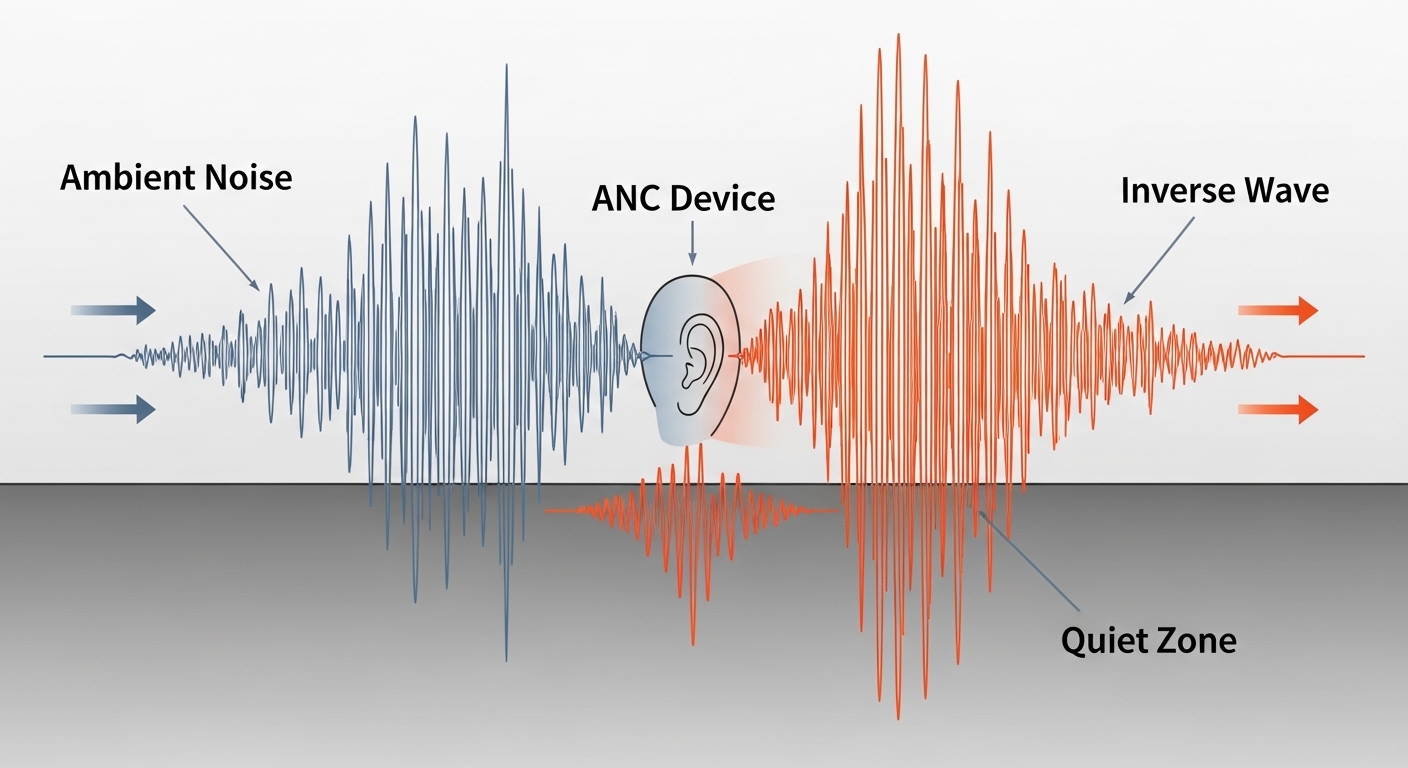
ANC systems use microphones to sample external sound and small speakers to play anti-noise that interferes destructively with incoming waves. That process is computational and dependent on microphone quality, digital signal processing (DSP), algorithm tuning, and the physical seal your headphones create. Budget models often slim down on one or more of these elements to hit a lower price point, which means their ANC can sound “thin,” inconsistent, or ineffective in some environments. By identifying which elements were compromised, you can prioritize features that matter to your listening habits instead of relying on price as a proxy for quality.
Over-Ear vs On-Ear Budget ANC Headphones: Which Is Better for Long Commutes?
When you commute, the shape of the headphone—over-ear versus on-ear—affects passive isolation, comfort over long sessions, and how well ANC performs in practice. Over-ear designs generally provide better passive noise isolation because the ear cups surround your ears and create a physical barrier to sound, which helps ANC do less work to reduce ambient noise. On-ear models sit on your ears and typically leak more sound, making it harder for ANC to create a convincing reduction in noisy environments. For long commutes where sustained comfort and predictable noise reduction matter, over-ear budget ANC headphones usually have the advantage because they combine physical isolation with the ANC system’s processing.
That said, on-ear options can be lighter, more portable, and sometimes cooler to wear for people who prefer less clamping pressure. If your commute is short or you value compactness and you primarily want to reduce low-frequency droning rather than complete isolation from conversations and abrupt noises, on-ear models can still be a sensible choice. The key is matching the form factor to how you travel, how long you’ll wear the headphones, and what kinds of sounds you need reduced.
Micro Component / Key Details
Budget ANC performance is the sum of small component choices. Here are the technical areas that most influence results, explained in plain terms so you can spot where compromises might matter for your needs.
Microphones: How placement affects performance
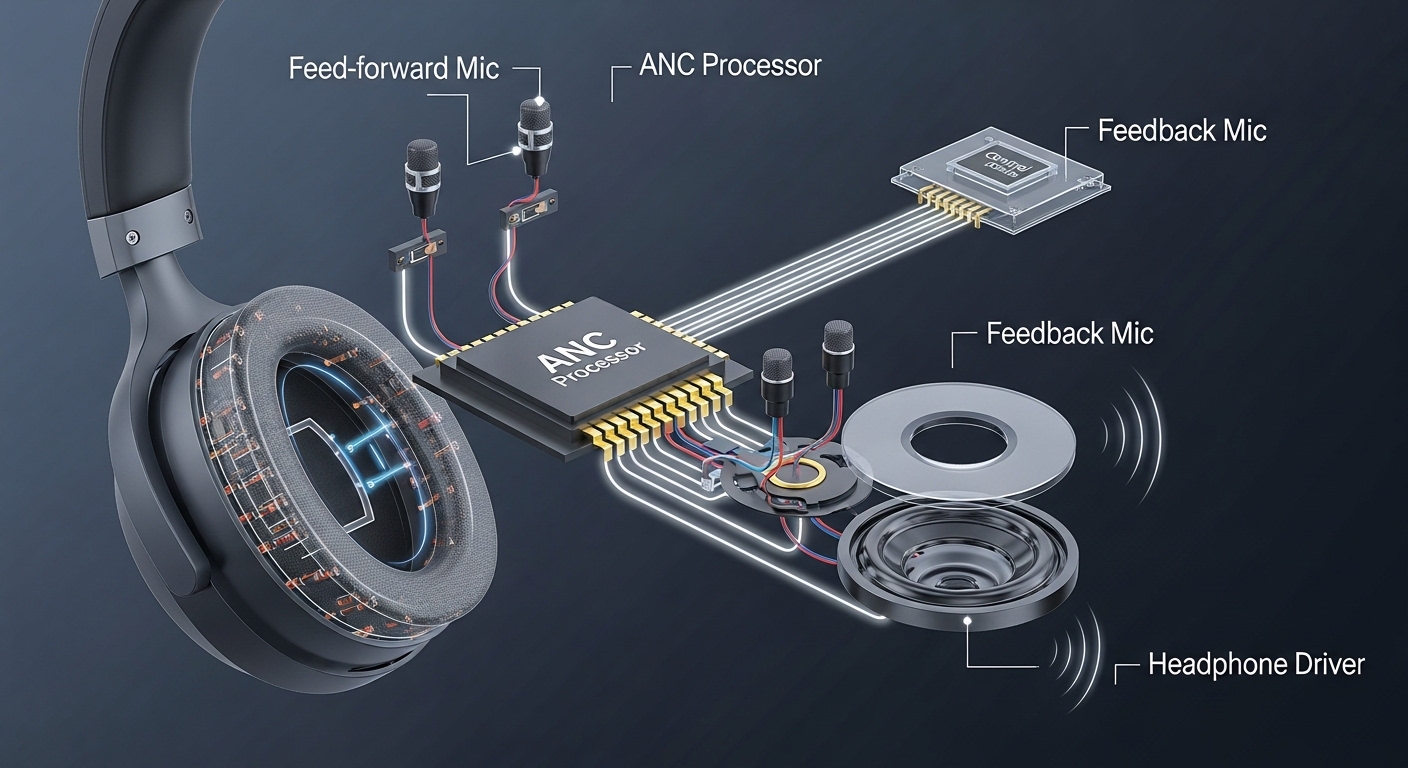
Microphones are the ANC’s ears. External mics capture ambient sound while internal mics monitor what reaches your ear. Placement, number, and quality of these mics determine how well the system can model and cancel noise. Budget designs often use fewer or lower-grade microphones, which reduces the bandwidth and fidelity of the noise profile they can capture. This typically results in ANC that’s good at suppressing steady low-frequency hums but weak on sudden noises and vocal sounds.
You should check whether the headphones advertise multiple microphones, and if possible, read real-world reviews that mention how the ANC handles speech and abrupt sounds. If you often travel on crowded trains or need to block human voices, the mic setup is a crucial area to consider.
DSP, latency, and filters
Digital signal processing (DSP) is where the captured sound is analyzed, and the anti-noise is generated. Effective DSP requires both capable algorithms and sufficient processing power. Budget headphones often use simplified DSP with conservative filters to avoid artifacts like pumping (audible volume fluctuations) or a hollow “phasey” sound, but this conservatism can lead to less aggressive cancellation.
Latency is another important factor—the DSP must produce anti-noise quickly enough that the phase relationship cancels the incoming wave. Lower-cost hardware may have higher latency or less computational headroom, punishing performance in complex noise environments. Good budget models focus DSP on low-frequency attenuation where latency and processing requirements are less demanding.
Drivers and acoustic design
Drivers convert electrical signals into sound, and their quality influences how music and anti-noise are reproduced. Cheap drivers can introduce distortion, limit frequency range, or produce an uneven response that makes ANC artifacts more noticeable. Acoustic design—cup shape, padding, and internal damping—affects how sound interacts with the driver and your ear, which in turn impacts perceived noise reduction.
When shopping, look for models with driver sizes and materials that reviewers note as “pleasant” or “balanced.” Even if ANC isn’t top-tier, better drivers can make music sound cleaner and less likely to be ruined by the cancellation process.
Battery and power management
ANC needs power to run mics and DSP continuously, so battery size and efficiency matter. Budget designs sometimes skimp on battery capacity to save cost, or they may implement aggressive power-saving modes that reduce ANC performance when battery levels drop. Battery life numbers in specs are useful but not definitive; real-world usage with ANC on tends to reduce runtime compared to passive listening via wired connections.
You should consider whether you’ll rely on ANC for long commutes, flights, or workdays away from charging. If so, battery life under ANC load is a practical metric to prioritize over advertised “play time” with ANC off.
Real-World Experience / Practical Insight
Theory explains how ANC works, but real-world use quickly reveals the true strengths and limits of budget models, especially during daily commutes and travel.. In daily use, you’ll notice that budget ANC is typically effective against steady, low-frequency sounds—think bus engines, airplane hums, or refrigerator noise. Mid- and high-frequency sounds, like chatter, door slams, and sudden announcements, are less consistently suppressed and may be heard as distant or toned-down rather than removed.
In everyday use, especially during longer listening sessions, many budget ANC headphones exhibit artifacts such as a sense of pressure, slight hissing, or a metallic taint to certain sounds when ANC algorithms work hard to cancel complex noise. These side effects vary by model and by how well the headphones’ microphones and DSP are matched and tuned. In practical use, fit proves to be one of the most decisive factors in how effective budget ANC feels, even when the headphones perform well on paper. Over time, foam pads compress and the fit changes, which can alter how ANC performs, so the longevity of materials matters for consistent results.
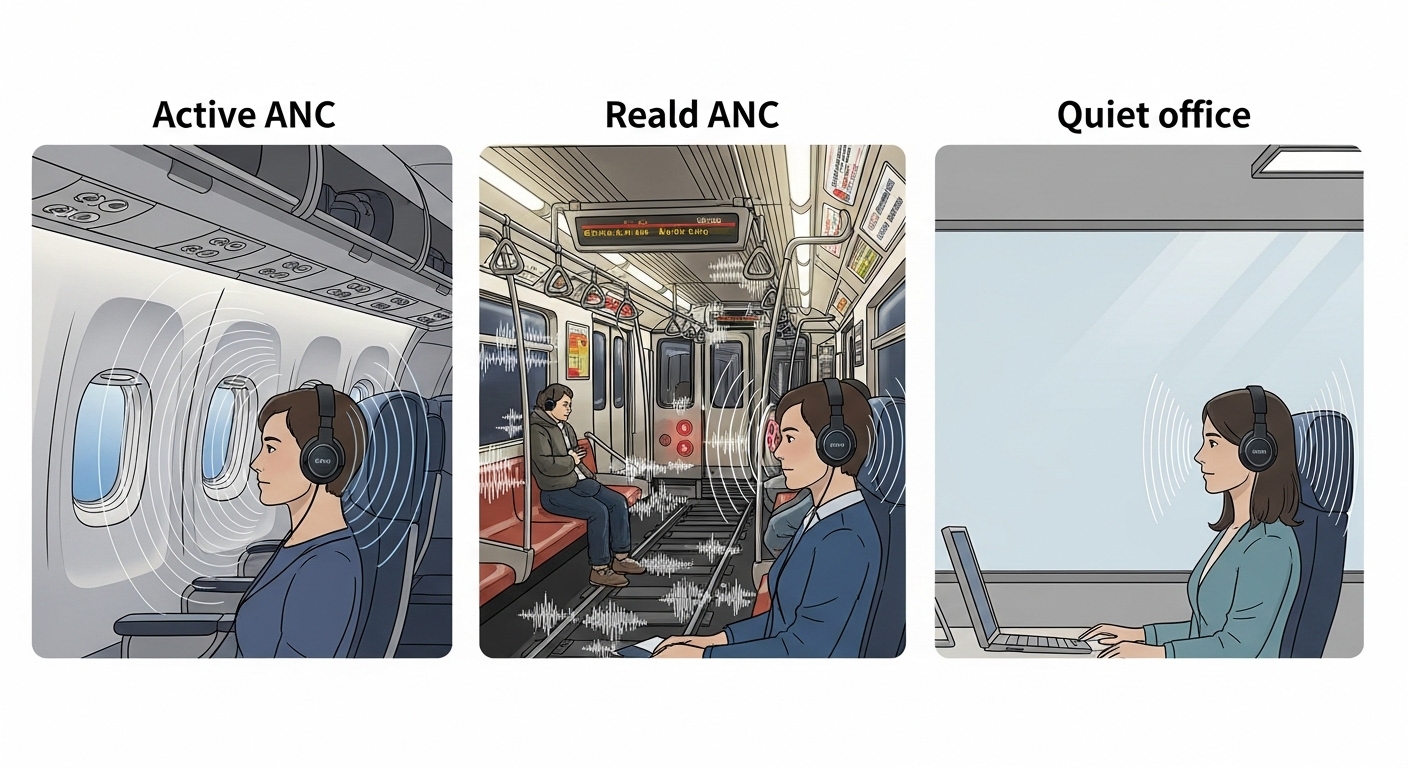
Environmental factors also matter. In a quiet office where you want to reduce keyboard noise and distant chatter, ANC might provide a modest benefit but passive isolation and good earcup padding will often have a larger impact. On a noisy subway, ANC can make a meaningful difference for bass-heavy noise, but it won’t fully eliminate nearby conversations. Software updates sometimes improve ANC behavior, so models with active firmware support can gain performance over time, whereas devices without ongoing support may stagnate.
Common Mistakes / Misunderstandings
Here are five common mistakes first-time buyers make with budget noise-canceling headphones, with clear explanations so you can avoid them.
Mistake 1 — Expecting ANC to be a complete replacement for passive isolation
Many buyers assume that ANC will remove all external noise, including nearby conversations and sudden sharp sounds. In reality, ANC works best on steady, low-frequency noise and cannot physically block all sound—especially high-frequency and impulsive noises. If you need near-complete silence (for sleeping in noisy places or blocking people nearby), passive isolation from well-sealed over-ear cups or earplugs may be more effective.
You should test how a candidate’s headset performs with and without ANC in environments similar to your typical use. For example, if you commute on a loud train, listen for whether voices remain clearly audible; if you need to block speech, prioritize models with strong passive isolation and thicker padding.
Mistake 2 — Assuming price alone guarantees adequate ANC performance
Price is a factor, but it’s not a guarantee of performance. Some mid-range models deliver excellent ANC for the money, while others spend budget on cosmetics and brand premiums rather than core ANC hardware and tuning. Conversely, some budget models punch above their price by smartly allocating resources to microphones and DSP.
Instead of relying on price as a proxy, read multiple real-world reviews focused on ANC behavior and look for frequency-specific tests or measurements when available. Real listening impressions will tell you more than a price tag.
Mistake 3 — Overlooking fit, comfort, and long-term wearability
You can get great ANC performance from a headset that’s intolerable to wear for long periods. Many budget options cut costs on padding and headband design, which can lead to pressure points, heat buildup, and fatigue during long commutes or work sessions. Remember that a comfortable fit not only affects your willingness to use the headphones but also the seal quality, which directly impacts ANC effectiveness.
Try to try-before-you-buy if possible, or buy from retailers with generous return policies. Check materials—memory foam earpads and a cushioned headband generally improve comfort and maintain a consistent seal over time.
Mistake 4 — Ignoring software, firmware support, and companion apps
Some budget ANC headphones rely on their hardware alone and offer little to no software for firmware updates, ANC modes, or EQ adjustments. That’s a mistake because ANC is part hardware, part software, and good tuning needs software updates and adjustable profiles. A model with a responsive app and regular firmware updates can improve ANC behavior or fix bugs, extending the life and value of the product.
Before you decide, check whether the brand provides an app and look for evidence of ongoing firmware updates or active customer support. If you plan to use ANC with specific devices (phones, tablets, laptops), verify compatibility and app availability on your platform.
Mistake 5 — Underestimating battery performance and real-world runtime with ANC on
Spec sheets frequently advertise long battery times, but those numbers often assume conservative usage or ANC off. Budget models may cut corners on battery capacity or power efficiency, causing noticeably shorter real-world runtimes when ANC is active. Running ANC continuously for a commute or a workday can drain cheaper batteries faster than you expect, leaving you without noise cancellation when you need it most.
Prioritize models that list ANC-on battery life or consult hands-on reviews that report real-world runtimes. Also consider charging options: fast charging, USB-C, or the ability to use the headphones wired while charging can be practical features for heavy users.
Evaluation / Authority Block
Evaluating ANC performance objectively involves both measurements and user experience. Measured metrics like frequency-specific attenuation curves, total harmonic distortion, and latency tell you how a system behaves in controlled environments. However, subjective measures—how the headphones make you feel on a bus, your tolerance for artifacts, and perceived comfort over hours—are equally important. A complete evaluation balances objective data with practical listening tests in real-world settings.
When you evaluate a model, look for independent measurements of noise attenuation at different frequencies and read multiple user reports about vocal suppression and sudden-noise handling. Tests that show how ANC behaves across frequency bands are particularly useful because they reveal where the system is strong and where it’s weak. If you’re unable to access detailed measurements, prioritize consistent real-world reviewer impressions from sources you trust.
Who This Is (and Isn’t) For
These insights are tailored to people who want a practical, affordable way to reduce environmental noise during commutes, light travel, or focused work sessions without paying premium prices. You benefit most if you:
- Spend time in steady-noise environments (trains, buses, offices) and want to reduce hum and rumble.
- Prefer a balance of music quality and noise reduction without needing audiophile-grade sound.
- Need good battery life for daily use and value software updates.
You might be better off looking beyond budget ANC if you:
- Require near-total noise elimination for sleep in very noisy settings.
- Want pristine ANC performance for professional audio work or critical listening.
- Need long-term durability and premium materials for heavy daily use, and don’t mind paying more.
Understanding your priorities allows you to choose a model that aligns with your use patterns rather than chasing an impossible “perfect” ANC experience at a budget price.
Practical Buying Checklist
Before you purchase, use this practical checklist to keep your expectations realistic and your purchase choice solid. Run through these points to avoid buyer’s remorse:
- Confirm the form factor (over-ear or on-ear) matches your comfort and isolation needs.
- Look for real-world battery tests with ANC on, not just manufacturer claims.
- Check whether a companion app or firmware updates are available.
- Read multiple reviews that describe ANC behavior in your typical environments.
- Verify return policy and warranty so you can test the fit and ANC in person.
Each item on this list helps you focus on what matters in daily use—seal and comfort, realistic battery life, software support, and real-world ANC behavior—rather than marketing claims.
How to Test ANC Before Buying
If you’re able to try headphones in person, even briefly, it’s one of the most reliable ways to judge how a budget ANC model will perform for you. Spend at least 10–15 minutes wearing the headphones quietly and comparing ANC on and off. Walk around in a busy area, listen to announcements at different volumes, and talk to someone briefly so you can hear how well speech is handled. Test with and without music, because ANC can interact with playback and create different artifacts.
If you can’t test in person, at minimum, watch demonstration videos that show ANC behavior in real-world noise, and prioritize reviews that include both objective measurements and long-term comfort notes. Also, be mindful of seller return windows so you can test at home.
Maintenance and Longevity Tips
To get consistent ANC performance over time, treat your headphones as you would any precision device. Keep microphones free of debris and moisture because blocked mics can distort noise detection. Replace earpads when they compress or wear out, as a degraded seal reduces both passive isolation and ANC effectiveness. Charge batteries responsibly—don’t leave them fully depleted for long periods—and check for firmware updates that might improve ANC behavior or battery management.
Materials matter. Budget models may use cheaper adhesives and plastics; if you plan to use the headphones daily for years, consider models known for easily replaceable earpads and swappable parts. That approach extends the usefulness of a budget purchase.
Common ANC Artifacts and How to Live With Them
Even with a good pair of budget ANC headphones, you may encounter artifacts like a low-pressure sensation (a “pushing” feeling), faint hissing, or a slight metallic tint to certain sounds. These are common with less refined ANC implementations. You can often mitigate discomfort by adjusting ANC modes if the device offers them, lowering ANC intensity if that option exists, or switching to passive mode in environments where ANC introduces annoying artifacts.
Listening with a moderate volume can sometimes mask minor artifacts without harming hearing, and taking occasional breaks helps avoid fatigue during long listening sessions. If artifacts are severe, they’re often a deal-breaker and worth returning the headphones for a different model.
When to Consider Spending a Little More
There are situations where spending a modest amount above the cheapest options can deliver disproportionate benefits. If you commute daily on crowded trains, fly frequently, or need consistent performance in a variety of noise conditions, models with slightly higher budgets typically offer better microphones, smarter DSP, and more comfortable materials. These mid-tier options often represent the best value for daily users because they blend usable ANC with longevity and software support, which cheap models may lack.
If your usage is occasional—maybe a few commutes and weekend trips—you can get acceptable value from entry-level ANC headphones, but if ANC is a daily necessity, consider stretching your budget to the models reviewers consistently recommend for balance and reliability.
Troubleshooting Common Problems
If ANC feels weak, check the seal and earpad condition first; poor fit is a frequent culprit. If you hear a persistent hissing or loud pumping, update the firmware and try different ANC modes. If the battery drains quickly with ANC on, test the headphones in airplane or battery-conserving mode and see if the behavior improves; a failing battery or poor power management in software may be the issue.
For intermittent ANC performance, test with different devices to determine if Bluetooth profiles or device compatibility is causing issues. Wired connections typically bypass some wireless limitations and let you isolate whether the problem is ANC hardware or wireless performance.
Conclusion
Budget ANC headphones can offer meaningful noise reduction for everyday use, especially against steady, low-frequency sounds found on trains, buses, and planes. However, first-time buyers often make predictable mistakes: expecting complete silence, trusting price alone, ignoring fit and comfort, overlooking software support, and underestimating ANC-on battery life. By understanding the core components—microphones, DSP, drivers, and battery—and testing candidates in real-world conditions or through trusted reviews, you’ll be able to choose a pair that aligns with your habits and expectations.
Remember: ANC is a tool, not a miracle. Match the headphone’s strengths to your needs, prioritize comfort and a good seal, and factor in software and battery support for long-term satisfaction. With that approach, you’ll maximize the value of a budget purchase without being surprised by limitations.