

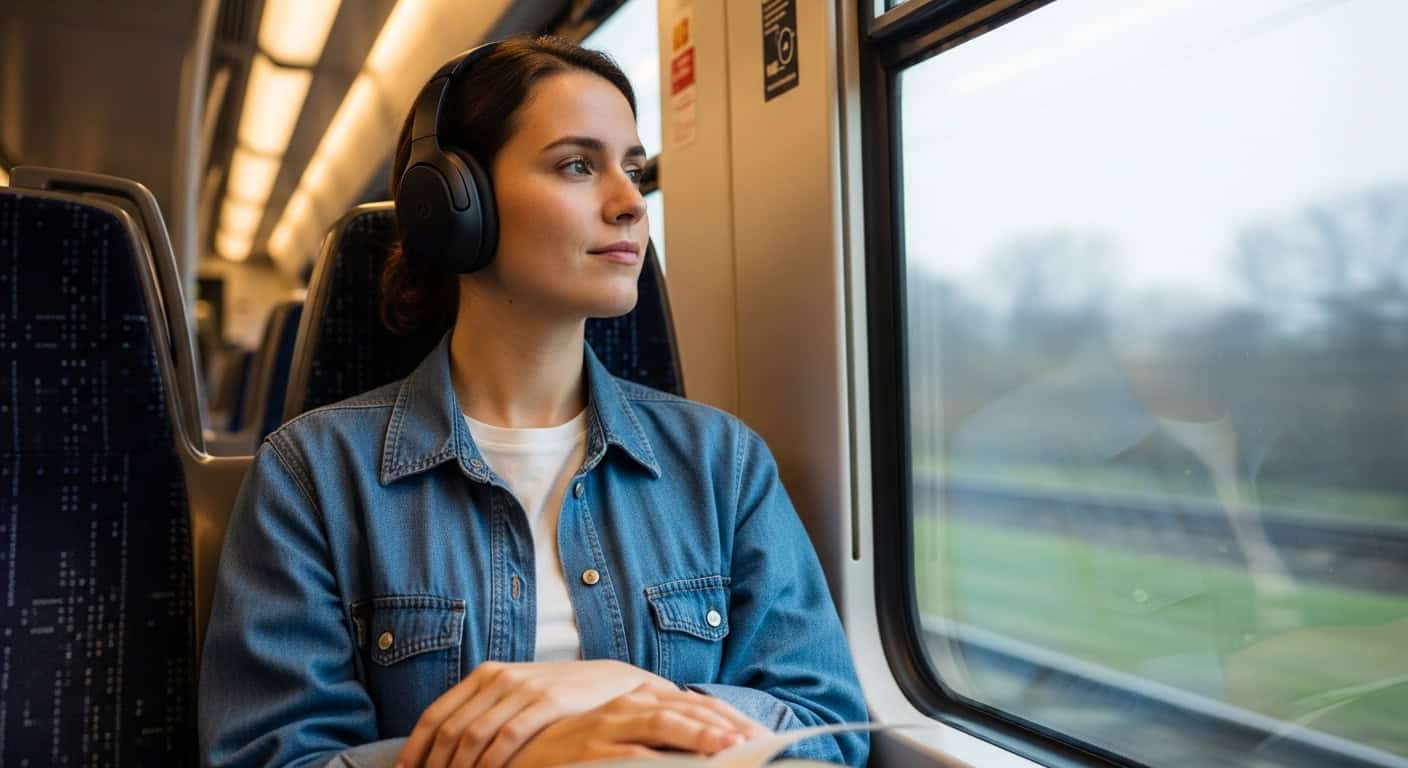
Understanding how active noise cancellation works helps you judge headphones by what they can realistically do. ANC uses microphones and electronics to reduce some of the surrounding sound you hear. It can make a steady background rumble less noticeable, but it does not create complete silence or guarantee that every distraction will disappear.
The useful question is whether a particular pair makes your normal listening environment easier to manage. A commuter, someone taking calls at home, and a person recording in a quiet room may need different features. Start with the sounds and tasks that matter to you, then check the exact model, its fit, and its available listening modes.
This guide explains the technology and offers practical buying checks. It is based on manufacturer documentation and public safety guidance, rather than a claim that we tested all ANC headphones together. For the wider choice between headphone styles and connections, use our main headphone buying guide.
1. ANC adds an electronic layer to the physical fit
Headphones can reduce some outside sound through their physical construction. Earcups, cushions, or ear tips create a barrier between the surrounding environment and your ears. This is passive isolation. ANC adds microphones, processing, and a cancellation signal to that physical design; the two approaches are different parts of the overall result.
You can think of passive isolation as the fit you establish when you put the headphones on, and ANC as an additional operating feature. That distinction is useful when comparing products. A pair can have closed earcups without having ANC, and the presence of ANC does not tell you whether its cushions or tips will fit you well.
During a fitting, notice whether you keep readjusting the headphones. Use the glasses you normally wear and check the headband or ear-tip arrangement according to the instructions. Do not assume that a photograph, a large earcup, or a marketing label establishes the same result for every listener. Our ANC versus passive noise isolation guide explains the distinction further.

2. Microphones and processing produce anti-noise
An ANC system uses microphones to sample sound and processing to produce an opposing signal through the headphone speakers. When the relevant sound pressures combine appropriately near the listener’s ears, some unwanted sound is reduced. This is commonly explained using destructive interference. Bose describes the combination of microphones, processing, and passive isolation in its noise-cancelling headphone explanation.
The familiar picture of two perfectly opposite waves is a simplified explanation. It should not be read as a promise that headphones erase every sound throughout a room. The system operates in the listening arrangement created by the headphones, and the result depends on the product and how it is worn.
This is why a demonstration needs more than an impressive graphic. When trying headphones, compare the same environment with ANC enabled and disabled, using the product’s actual controls. Check which mode the app or spoken prompt reports. Keep your audio at a comfortable level and concentrate on the sounds you are trying to reduce rather than raising the music to make the comparison seem more dramatic.

3. Steady background sounds are a useful starting point
Sony explains that noise cancellation is particularly effective against steady low- and medium-pitched background sounds, while changing sounds such as speech can remain audible. Its noise-cancellation support guide also makes clear that surrounding noise is reduced rather than removed altogether. Think of an engine-like rumble as a more realistic demonstration than a promise to silence an entire conversation.
For your own shortlist, name the environment instead of simply asking for the strongest ANC. You might care about a bus ride, an air conditioner, or background activity near a desk. These are different situations, so look for information that matches the one you encounter most often. A review describing a flight is useful context, but it does not establish how every home or office will sound.
Avoid testing with hazardous sound sources. You do not need to stand near loud equipment or create sudden loud noises to judge a consumer listening feature. If your actual task requires hearing protection, address that requirement separately. For ordinary shopping comparisons, use normal listening conditions and a seller’s return period where available.

4. Feedforward, feedback, and hybrid describe the design
Feedforward ANC uses microphones outside the earcups or earpieces to detect surrounding noise. Feedback ANC uses microphones inside the listening space to monitor the sound there. Hybrid ANC combines these approaches. Jabra explains the microphone arrangements in its ANC technology guide.
These terms help describe how a system is arranged. They do not provide a universal ranking across brands or prices. A hybrid label alone cannot establish comfort, microphone quality, or the amount of noise reduction you will experience. Compare the exact models and the evidence available for them instead of treating the design term as a complete buying decision.
Adaptive ANC is another term to read in context. It usually describes adjustment of the noise-cancelling behavior as conditions change, but the controls and implementation belong to the individual product. Bang & Olufsen provides one documented example in its adaptive ANC explanation. Check the manual to see whether your candidate offers automatic adjustment, manual levels, or a choice of modes.

5. Listening ANC and call noise reduction do different jobs
Listening ANC concerns the surrounding sound reaching the person wearing the headphones. Microphone noise reduction concerns the audio sent to someone else during a call. A product may include features for both, but a strong claim about one does not prove performance in the other. Sony’s support explanation specifically distinguishes the listener’s noise cancellation from the sound received by the other caller.
For meetings, make a short test in the application you actually use. Speak from your usual chair, with the microphone positioned according to the instructions. Ask someone how clear your voice sounds, or make a recording using an available recording feature. Compare that result with your normal setup. Do not decide microphone quality by how quiet the headphones sound to you.
Check the connection as part of the same test. If you switch between a phone and laptop, confirm the model’s supported behavior and try the transition during a normal task. Our headphones for work and calls guide helps turn those practical requirements into a shortlist.
6. Fit, controls, and carrying space matter alongside ANC
Over-ear headphones and earbuds can both offer ANC. Neither category guarantees the best noise reduction or comfort for every buyer. Compare the actual product’s fit and controls, and check the size of the case you will carry. Our over-ear versus on-ear comparison provides a related set of fitting checks.
Try the listening modes without repeatedly consulting the app. Can you pause quickly, find the volume buttons, and understand whether ANC or an ambient-listening mode is active? If you need to hear someone nearby, stopping playback and removing the headphones may be the clearest choice. Do not rely on a mode name as a guarantee that every important sound will remain noticeable.
Include ownership details in the comparison. Read the battery figure for the mode you intend to use, check whether a case is included, and verify any wired-listening requirements. A long battery claim measured with ANC disabled is not the same specification as runtime with ANC enabled. Our wired versus wireless headphone guide covers that separate connection choice.

7. Consumer ANC is not automatically hearing protection
Do not treat an ordinary ANC headphone as protective equipment for hazardous noise. NIOSH states that ANC headphones or earbuds should not be considered hearing protection unless labeled with a Noise Reduction Rating. Its hearing protection guidance also emphasizes appropriate selection, fit, and consistent use.
That is different from choosing a listening feature that makes everyday background noise less distracting. A quieter-feeling environment does not by itself establish that exposure is safe. For a workplace or activity requiring hearing protection, use equipment appropriate to that situation and follow the applicable safety instructions. Do not substitute a consumer headphone’s ANC setting for that process.
Music volume and listening duration still deserve attention. Noise cancellation is not permission to listen louder or for an unlimited time. If using headphones is uncomfortable, stop the session instead of trying to push through it. Our purpose here is to explain a buying feature, not to certify a product or listening routine as safe for every person.
Three familiar models: compare documentation, not a universal winner
The Sony WH-1000XM5, original Bose QuietComfort Ultra, and Soundcore Space Q45 are examples of models with noise-cancelling features. They are included to show how to check documentation, not as a claim that they were tested together or that one wins every category. Use each exact model’s own page and instructions before comparing offers.
Sony’s WH-1000XM5 product page identifies that specific model. Do not apply information about the differently named WH-1000XM6 to it. When viewing a listing, match the model name, supplied accessories, condition, and seller terms rather than assuming that a similar-looking name describes the same purchase.
For Bose, distinguish the original QuietComfort Ultra announcement from documentation for a later generation. For Soundcore, read the Space Q45 discontinuation notice. Soundcore states that the Q45 is no longer sold on its official US site as of November 2, 2026; other retailers may have remaining stock. Treat it as a previous-model example and do not borrow specifications from a different Space model. This simple identity check helps prevent mixed battery figures, connection features, and expectations.
Compare the total offer after establishing the features you need. Check returns, included cables, case dimensions, and support arrangements. If budget is the main constraint, our budget noise-cancelling headphone comparison provides a more focused next step. Our guide to common budget-headphone buying mistakes adds questions to consider before checkout.
A practical way to compare two pairs
Start with a short description of your normal task: where you listen, what you need to hear, how long you wear headphones, and which devices you use. Then choose a familiar piece of audio and keep the conditions similar when comparing products. This is a personal fitting and usability check, not a laboratory measurement of ANC performance.
For each pair, note the mode you selected, whether you kept repositioning it, and whether you could operate the controls comfortably. Check the carrying arrangement and try a normal call if that matters to you. A brief written note makes it easier to remember the difference after several demonstrations, especially when product descriptions use similar language.
Before ordering, read the seller’s return conditions, including whether opened headphones are accepted and who pays return shipping. Keep the packaging while you complete your normal fitting checks. No specification sheet can promise that a headphone will feel right on your head or suit every part of your routine.

Frequently asked questions
Does ANC work without music?
It can. Bose explains that active noise cancellation operates separately from music playback on its noise-cancelling headphones. Check the exact model’s power and mode instructions. Being able to use ANC without a song playing does not mean the headphones can cancel noise when their electronics are switched off or their battery is empty.
Will ANC remove conversations completely?
Do not expect complete silence. Changing sounds such as speech can remain audible, and the result varies by model and fit. If conversation is your main distraction, look for relevant evidence and try the product during a normal return period rather than buying from a blanket promise that every voice will disappear.
Does a hiss always mean the headphones are faulty?
A hiss alone does not establish the cause. Compare the listening modes and audio sources, and consult the troubleshooting instructions for that model. If the behavior persists or seems abnormal, contact support. Avoid describing every noise as normal, and do not increase music volume simply to cover an unexplained problem.
Choose ANC for the task you actually have
Use the technology explanation to set realistic expectations, then judge the complete headphone. Fit, controls, calls, connections, carrying space, and seller terms all affect whether it suits your day. ANC can be useful, but its presence does not establish a universal winner, a microphone result, or a hearing-protection rating.

Take the free headphone checklist with you
Get our one-page Before You Buy Headphones checklist, with seven practical checks covering compatibility, comfort, microphone quality, noise control, and total cost. Subscribe to TopProdReviews for the checklist, helpful headphone buying tips, product comparisons, and occasional product recommendations. Unsubscribe anytime.
Get the Free Headphone Checklist.
Confirm your email address to open the PDF. Privacy policy.
Continue reading
For the physical design decision, read over-ear versus on-ear headphones. For product-specific shopping questions, continue to five budget ANC headphones compared.