

Introduction
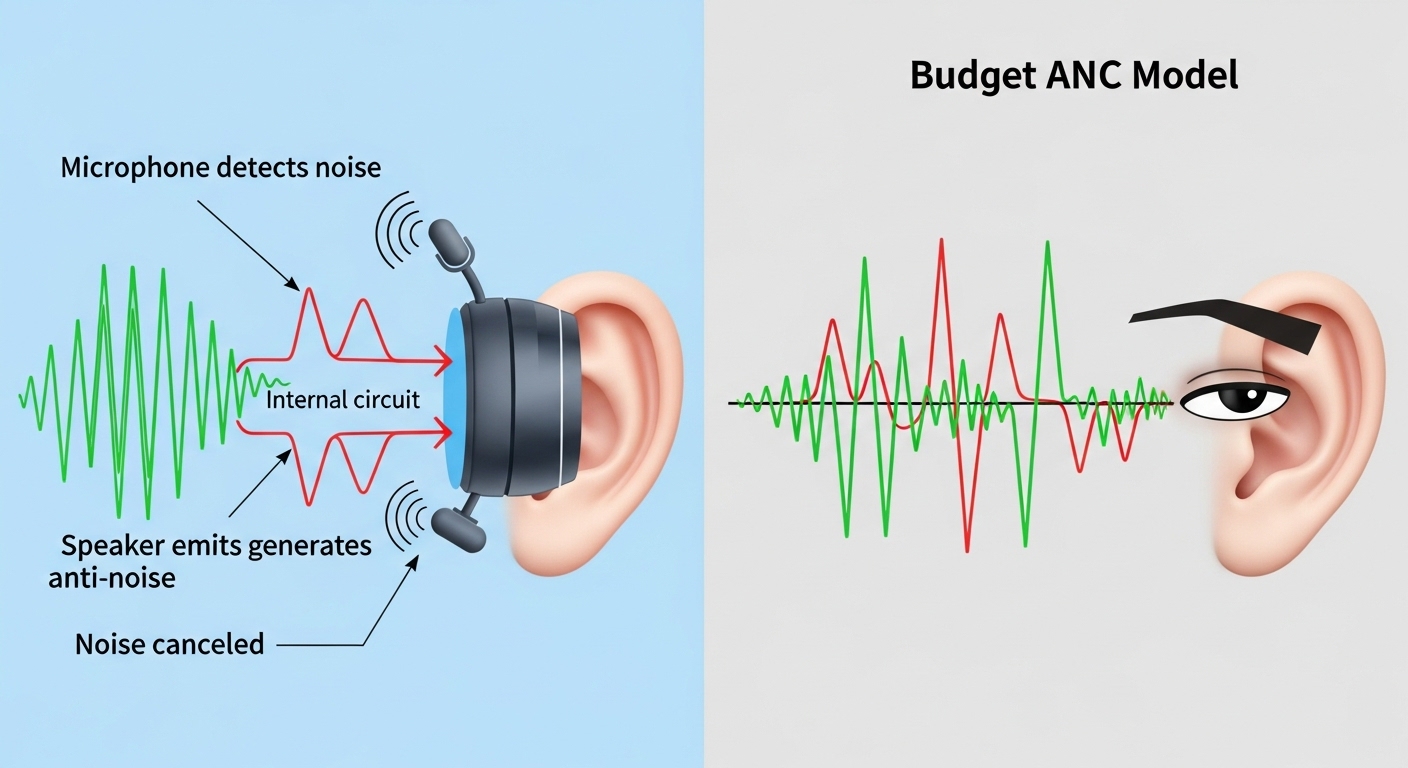
You’ve probably heard the term “active noise cancellation” (ANC) thrown around when people talk about headphones, earbuds, or smart speakers. At a glance, it looks like magic: you press a button and the world gets quieter. In reality, ANC is a combination of physics, electronics, and software that works best when multiple pieces cooperate.
Understanding the basics helps you make smarter choices and sets realistic expectations for what ANC can — and can’t — do.
This article is for anyone curious about why some budget models promise the moon but deliver only a faint whisper of difference. By the end, you’ll understand the core principles of ANC, common trade-offs, and what to look for when comparing models — all without technical overload or hype.
Core Explanation / Problem
Active noise cancellation reduces unwanted ambient sound by generating a sound wave that is the inverse of the noise you want to eliminate. When two waves with equal amplitude and opposite phase meet, they cancel each other out — that’s destructive interference.
ANC Inverse Sound Waves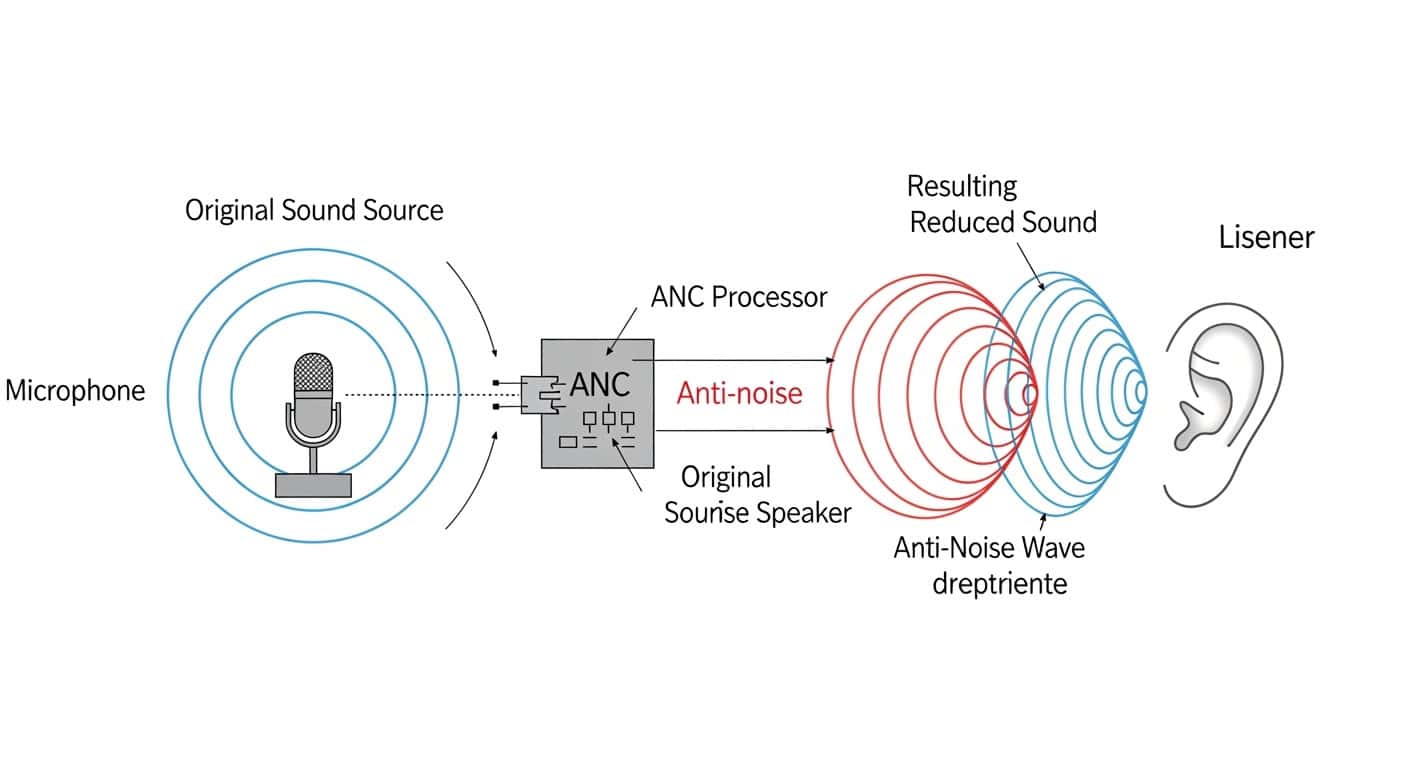
The engineering challenges are significant. For ANC to work effectively, the system must detect noise early, compute and generate the inverse waveform with very low latency, and deliver it accurately at the ear. Any delay, incorrect amplitude, or phase error reduces cancellation. This is why microphone quality, DSP speed, driver performance, fit, and power all matter.
ANC is most effective at steady, low-frequency noise like airplane engines or bus motors. High-frequency, transient, or variable noises (like people talking or door slams) are harder to cancel. ANC cannot create perfect silence and may introduce artifacts like hissing or slight changes in music quality. Recognizing these trade-offs helps you evaluate headphones realistically.
Microphones: The Sensory Front Line
Most ANC designs use a combination of external (feedforward) and internal (feedback) microphones.
-
Feedforward: Picks up noise before it reaches your ear.
-
Feedback: Monitors what reaches the ear canal and corrects residual noise.
Microphone Placement in ANC Headphones
Cheap microphones add self-noise and reduce the fidelity of the inverse waveform, increasing artifacts. Budget models often struggle here.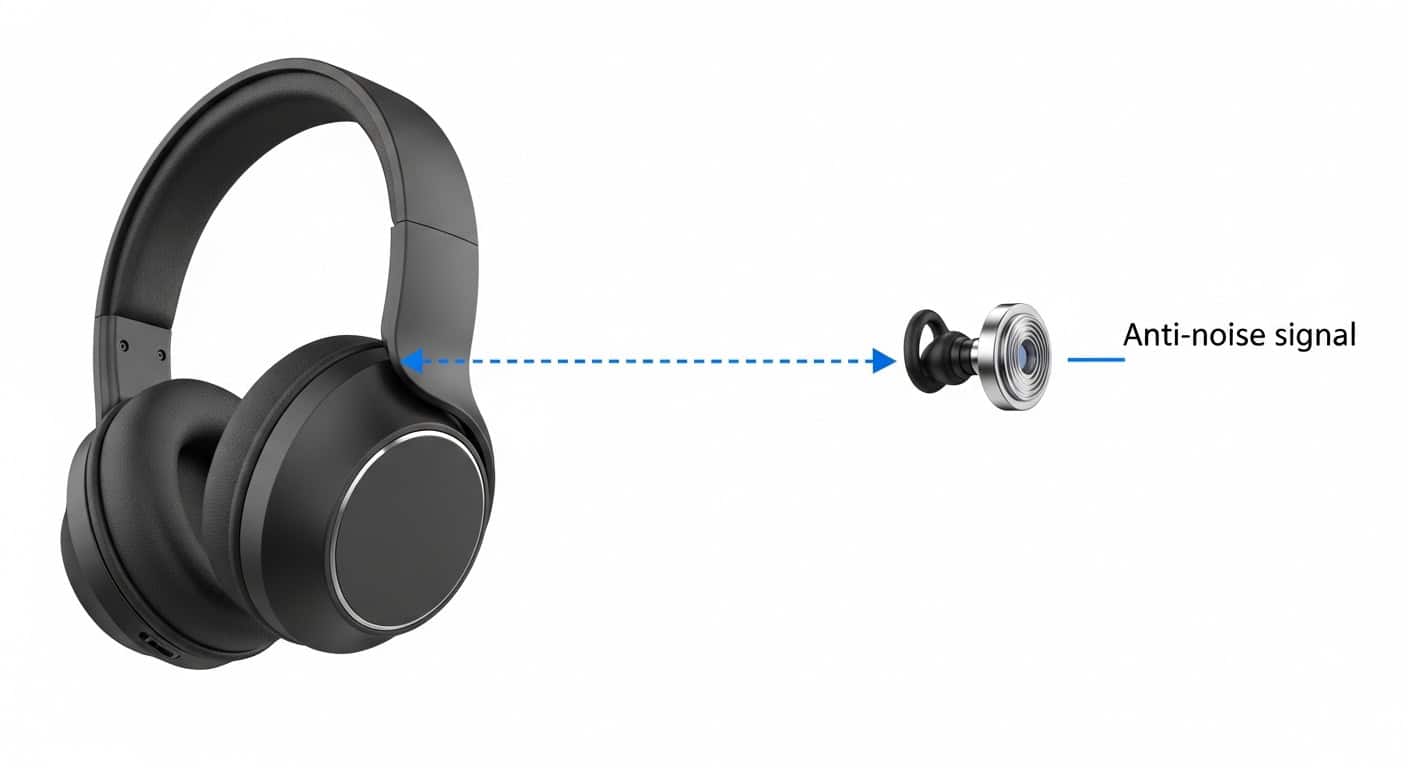
DSP, Latency, and Filters
Once microphones capture sound, a digital signal processor (DSP) analyzes it and generates anti-noise. Low latency is critical; if DSP is slow, the anti-noise will be out of phase. High-end ANC uses optimized DSP chips and adaptive algorithms to maintain stability.
-
Adaptive filters: Adjust parameters to shifting noise profiles.
-
Latency issues: Higher frequencies are harder to cancel due to precise timing requirements.
Frequency Effectiveness of ANC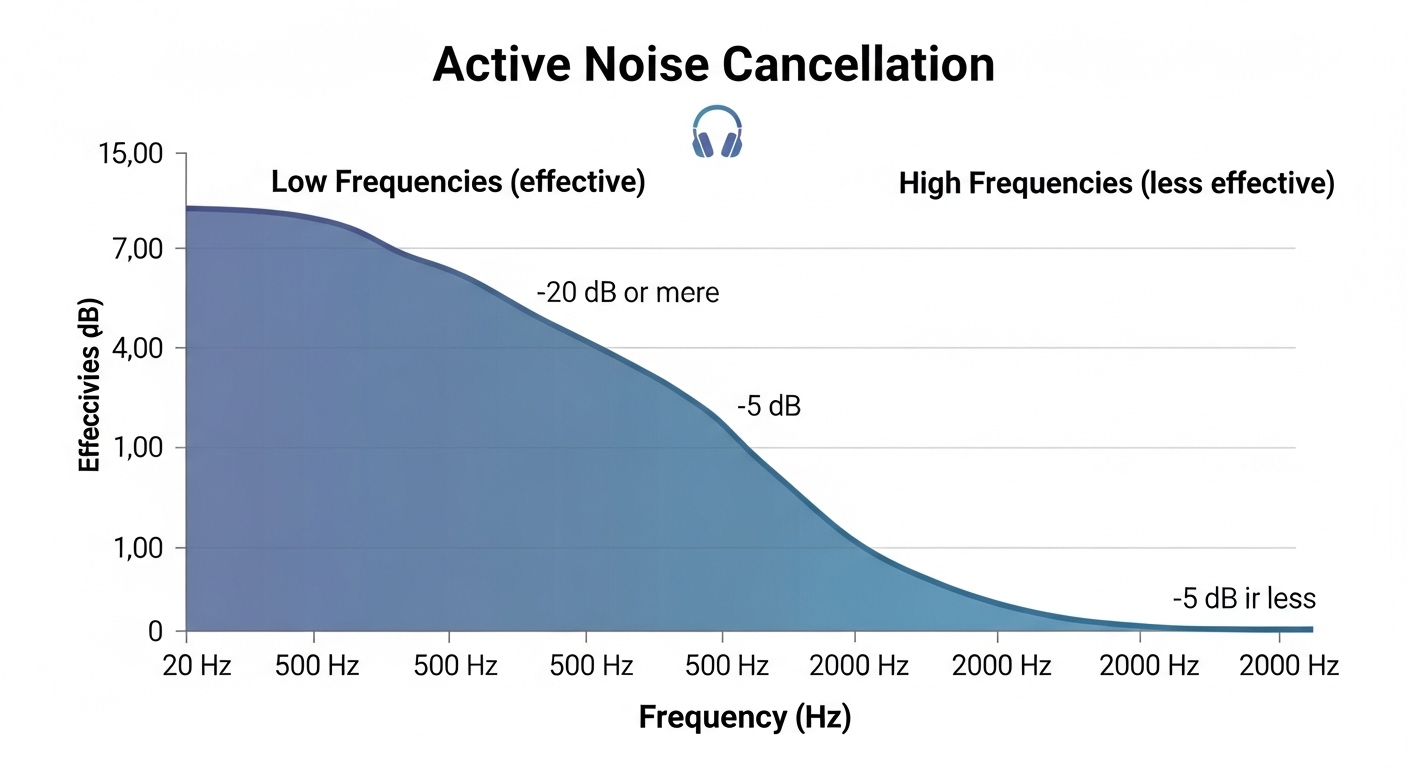
Simpler DSP implementations may produce pumping or fluctuating cancellation. This explains why ANC works better for steady rumble than for unpredictable sounds.
Drivers, Acoustic Design, and Fit
Headphone drivers must faithfully reproduce the anti-noise. Poor transient response or weak low-frequency extension reduces cancellation. Mechanical design — earcup seal, headband clamping, and ear tip fit — also matters.
-
In-ear models rely on tip seal for ANC effectiveness.
-
Over-ear models rely on clamping force and cushion design.
Budget models often compromise on these, resulting in inconsistent performance.
Power and Thermal Limits
ANC consumes battery power for microphones, DSP, and electronics. Smaller batteries or less efficient hardware may force reduced ANC performance to prevent overheating or preserve battery life.
Real-World Experience / Practical Insight
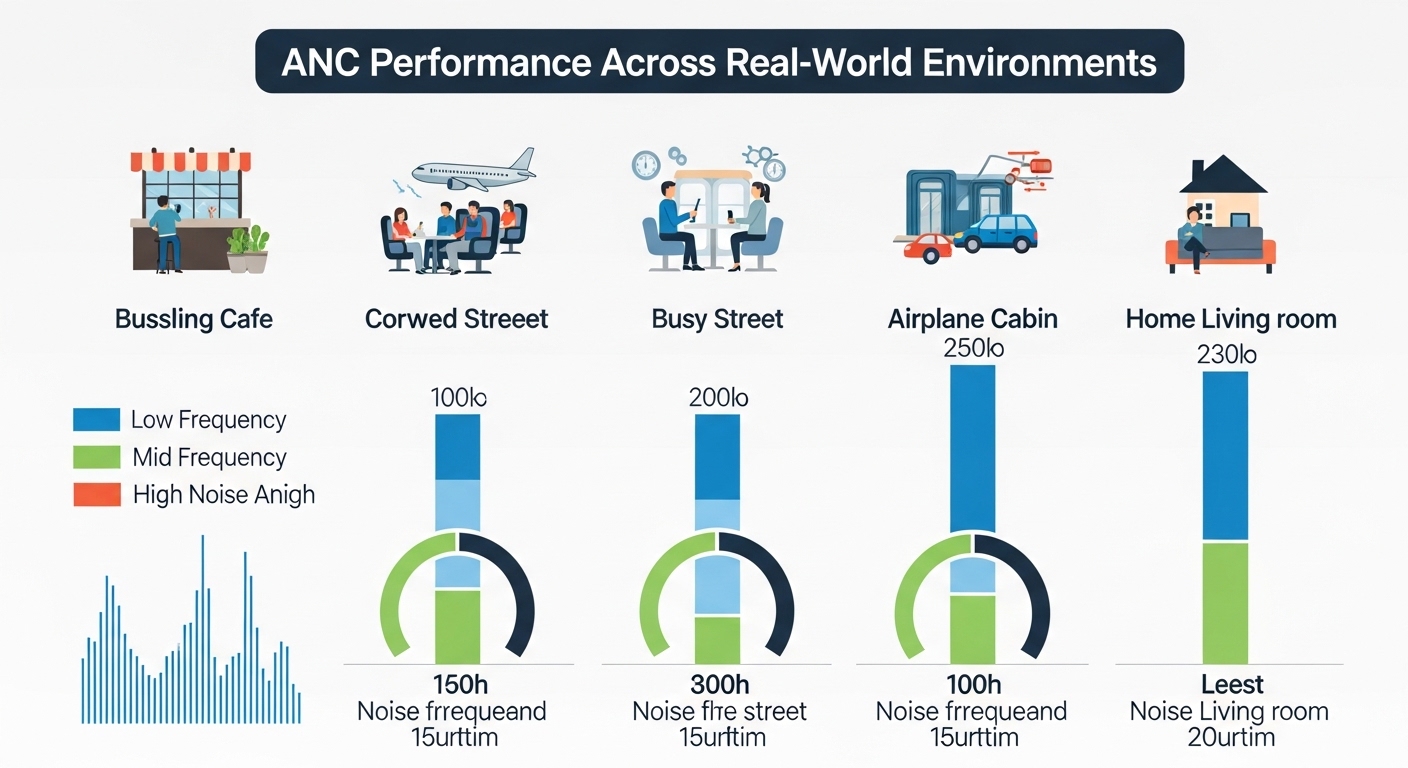
In everyday use, ANC results vary by environment:
-
Airplane or train: Substantial reduction in engine and road noise.
-
Café or office: Edge is taken off background hum, but conversations remain audible.
ANC Effectiveness Across Environments
Users notice:
-
Reduced low-frequency noise
-
Slightly altered sound signature
-
Occasional artifacts (hissing, pumping, swishy sounds)
Fit impacts performance. Loose earbuds or poorly clamped over-ear cups reduce cancellation. Over time, battery aging, firmware updates, and cushion wear can influence ANC performance.
Common Mistakes / Misunderstandings
-
Expecting ANC to replace passive isolation.
-
Assuming ANC is equally effective across all frequencies.
-
Believing higher price guarantees better performance.
-
Ignoring battery life reduction with ANC enabled.
-
Overlooking fit and comfort, which directly affect performance.
How We Evaluate This
We assess ANC through:
-
Controlled measurements: frequency-specific attenuation, latency, mic quality
-
Real-world tests: planes, trains, buses, offices
-
User experience: ambient modes, tonal colorations, call quality
-
Fit and comfort evaluations
This approach combines objective metrics and practical use, helping readers match a product to their priorities.
Who This Is (and Isn’t) For
-
Useful: Travelers, commuters, open-office workers, anyone reducing long-term listening volume.
-
Less useful: People who want full situational awareness, or prioritize purely natural sound reproduction.
-
Budget: Affordable models can still provide meaningful low-frequency noise reduction, but with realistic expectations.
Conclusion
ANC is a powerful but complex technology. It excels in low-frequency, steady noise environments, improving comfort and clarity. Budget models struggle because ANC relies on the entire signal chain: microphones, DSP, drivers, fit, and power.
To get the most value:
-
Focus on seal and comfort
-
Check measured battery life with ANC enabled
-
Pay attention to real-world performance reviews
-
Consider firmware updates and long-term upkeep
With realistic expectations and basic understanding, ANC can significantly enhance your daily life.