

Last Updated: February 2026
We periodically revisit our reviews to ensure information reflects current firmware, pricing trends, and availability.
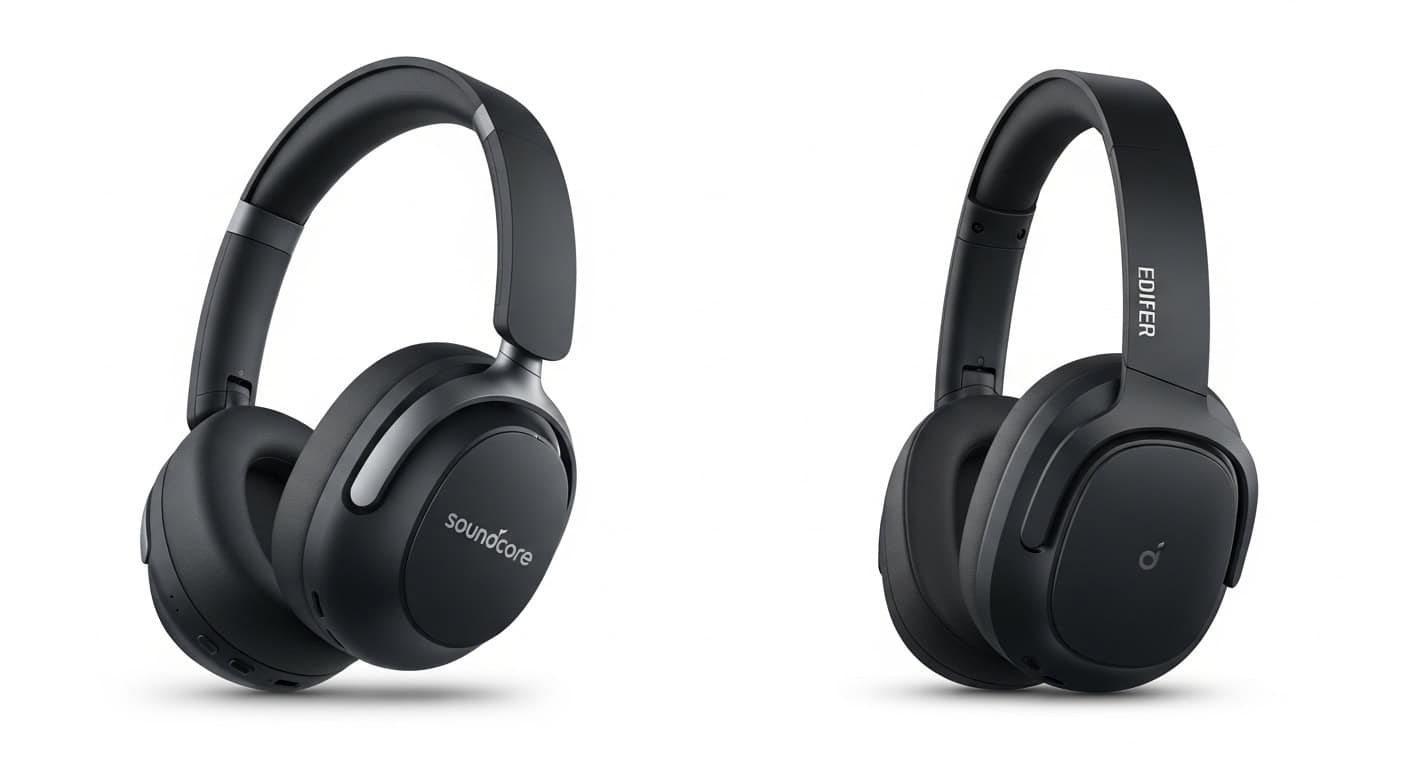
You’re looking at two of the most talked-about budget ANC headphones in recent years, and for good reason. The Soundcore Life Q30 and the Edifier W820NB Plus (Gen 2) have both shown up repeatedly as sensible, affordable choices if you want active noise cancellation without breaking the bank. This comparison exists to help you choose the right pair for your real-world needs in 2026, not to convince you that either is a flagship replacement.
Expectations matter: budget ANC won’t match the noise cancellation, build quality, or feature depth of premium models, but both of these options deliver a compelling mix of sound, battery life, and features for the price. If you want a quick primer on the core buying considerations for inexpensive ANC headphones before you dive into the details here, check this guide on what to look for when buying budget noise-canceling headphones.
How We Compare Headphones at TopProdReviews
Our comparisons focus on everyday listening situations rather than laboratory measurements. We consider how headphones behave during commuting, office work, long listening sessions, and travel.
We weigh comfort over short demo impressions, evaluate how stable wireless connections remain across devices, and pay attention to whether app features meaningfully improve long-term usability.
The goal is simple: which model is easier and more satisfying to live with day after day.
Before we compare sound, comfort, and ANC performance…
👉 How we test
If you want to understand how we evaluate comfort, ANC accuracy, and long-term durability, see 👉 How We Test & Review Products.
Quick Comparison Overview
Below is a high-level comparison to help you orient quickly. The entries are meant to summarize typical performance and value in 2026 after minor firmware revisions and continued use by owners. Here’s a quick side-by-side to highlight the practical differences most buyers care about in daily use.
| Feature | Soundcore Life Q30 | Edifier W820NB Plus (Gen 2) |
|---|---|---|
| Price range | Very budget-friendly; often discounted | Budget-friendly; occasionally slightly higher than Q30 |
| Noise cancellation | Strong for low-frequency hums; multi-mode ANC | Competent ANC with balanced reduction; improved in Gen 2 |
| Sound signature | V-shaped: emphasized bass and treble, warm midrange | More balanced; clearer mids, controlled bass |
| Battery life (ANC on/off) | ~35–45h ANC on, 60+h ANC off (realistic range) | ~40–50h ANC on, 60h+ ANC off |
| Comfort | Moderate clamp, plush pads, slightly bulkier | Lighter clamp, shallower profile, good for longer wear |
| App & EQ | Feature-rich Soundcore app, 10-band EQ and presets | Edifier Connect app, simpler EQ and presets |
| Bluetooth & multipoint | Stable single-device; multipoint available but flakey in places | Multipoint implemented well in Gen 2; stable with recent updates |
| Best for | Bass-forward music, home/office use, long battery life | Voice clarity, mixed-use commuting, travel with comfort |
This table gives a starting point. Below you’ll find a deeper look at the areas that matter most when you’re actually using these cans day to day.
A Note on Expectations
Neither of these headphones is designed to defeat premium models that cost two or three times more. What they aim to do is deliver the biggest practical improvement per dollar.
When people are happy with their purchase, it’s usually because they focused on comfort, battery life, and tonal preference rather than expecting miracle levels of silence.
Quick price check:
You can compare current prices for the Soundcore Life Q30 and Edifier W820NB Plus (Gen 2) on Amazon to see which one offers better value right now.
👉 Link:

Active noise cancellation is often the deciding factor when you buy budget ANC headphones, but implementations vary more than you might expect. You need to know where each model performs well and where it won’t meet your expectations.
Both models reduce steady, low-frequency sounds like airplane engine hums and bus rumble. The Life Q30’s ANC has historically excelled at low-frequency attenuation, which makes it better at taking the edge off long-haul flights or noisy HVAC systems in offices. The Q30’s ANC behavior feels a touch more aggressive on bass-heavy noise, which you may notice as a stronger “pressurized” sensation when ANC is engaged.
The Edifier W820NB Plus Gen 2 targets a slightly different balance. Its ANC tends to be more even across frequencies, which helps maintain vocal clarity near you while still cutting background hum. On commutes with mixed noise (brakes, chatter, intermittent traffic), the Edifier can sound less intrusive and more natural. The Gen 2 improvements make it feel closer to a neutral, less colored cancellation.
Transparency and ambient modes are useful when you need situational awareness. Neither model matches premium pass-through realism, but both do a competent job. The Life Q30’s transparency mode can sound somewhat processed — voices are audible but tinged by a mild processing artifact. The Edifier’s ambient mode usually delivers a cleaner reproduction of speech and city noises, which can feel more usable for quick conversations or hearing announcements.
In short, choose the Life Q30 if you prioritize stronger low-frequency reduction for long flights or steady office hum. Choose the Edifier W820NB Plus Gen 2 if you want more natural ambient pass-through and a balanced ANC profile for mixed urban noise.
For a deeper look at how the Edifier model performs in different noise environments, see the full Edifier W820NB Plus Gen 2 review.
Low-frequency noise reduction
Low-frequency noise is the easy win for budget ANC and tends to be the focal point for most buyers. The Q30’s ANC often pulls ahead here; you’ll notice less rumble on planes and trains. The Edifier reduces the same frequencies but with a less aggressive slope, which preserves some body of music and speech.
Commuting, office, and travel use
If you commute daily in a mix of buses and trains, the Edifier’s balanced approach may be less fatiguing across a long day. If you travel by plane frequently and want to dull engine noise for rest, the Q30’s stronger low-end cancellation can make naps and focus easier.
Transparency / ambient mode realism
Both models offer a pass-through that’s good enough for safety and convenience. Expect modest processing in both. The Edifier generally sounds less processed, which is preferable for short interactions with staff or announcements.
What Owners Typically Notice After Weeks of Use
Over longer periods, differences in tuning and comfort tend to matter more than dramatic ANC claims. Many users report adapting quickly to the limits of cancellation, while small annoyances like clamp pressure or awkward controls become more important.
This is why long-session comfort and sound signature often determine which model people keep.
Sound Quality and EQ Flexibility
Sound quality is where personal preference matters most, and you’ll get the most value by matching the signature to the music and use you prefer. You’ll also want to know how much the respective apps let you shape that sound.
Out of the box, the Soundcore Life Q30 follows a V-shaped tuning philosophy. Bass is prominent and extends with force, mids are slightly recessed compared with the low-end, and treble is boosted to add clarity or sparkle. That makes the Q30 fun for modern pop, EDM, and bass-forward genres. If you prefer a warmer, fuller sound for vocals-heavy music, you may find the default tuning a bit too tilted toward sub-bass emphasis.
The Edifier W820NB Plus Gen 2 leans toward a more balanced presentation. Mids are more forward, and vocals retain better presence, which helps acoustic and vocal-centric tracks. Bass is present and controlled, but not as exaggerated as the Q30. You’ll find the overall texture cleaner, which can be preferable for podcasts and long listening sessions where vocal clarity matters.
Both apps matter because they let you compensate for the default tuning. The Soundcore app remains one of the most powerful in the budget space; its 10-band EQ, presets, and custom profiles let you tailor the Q30’s V-shape into something more neutral if you want. The Edifier Connect app is simpler but practical: you can adjust bass and treble and choose from a handful of presets without getting lost in bands.
If you want a full-length, model-dedicated analysis of the Q30’s tuning and EQ options, check the Soundcore Life Q30 review.
Default tuning comparison
The Life Q30 favors punch and excitement. If you like music that hits hard, you’ll probably enjoy it right away. The Edifier W820NB Plus Gen 2 favors clarity and balance; it’s easier to live with if you switch between music and spoken-word content frequently.
Bass, mids, treble differences
Bass: Q30 is deeper and more pronounced. Edifier is tighter and more controlled.
Mids: Q30 mids sit back; Edifier mids are clearer and more present.
Treble: Q30 has more emphasis for sparkle; Edifier is less bright but more natural.
App-based EQ usefulness
The Soundcore app gives you broad control and useful presets. That flexibility is valuable because it allows you to make the Q30 sound significantly more neutral. The Edifier app is straightforward and reliable; it won’t offend, but it won’t replace a detailed EQ if you’re an audiophile.
Comfort, Fit, and Build Quality
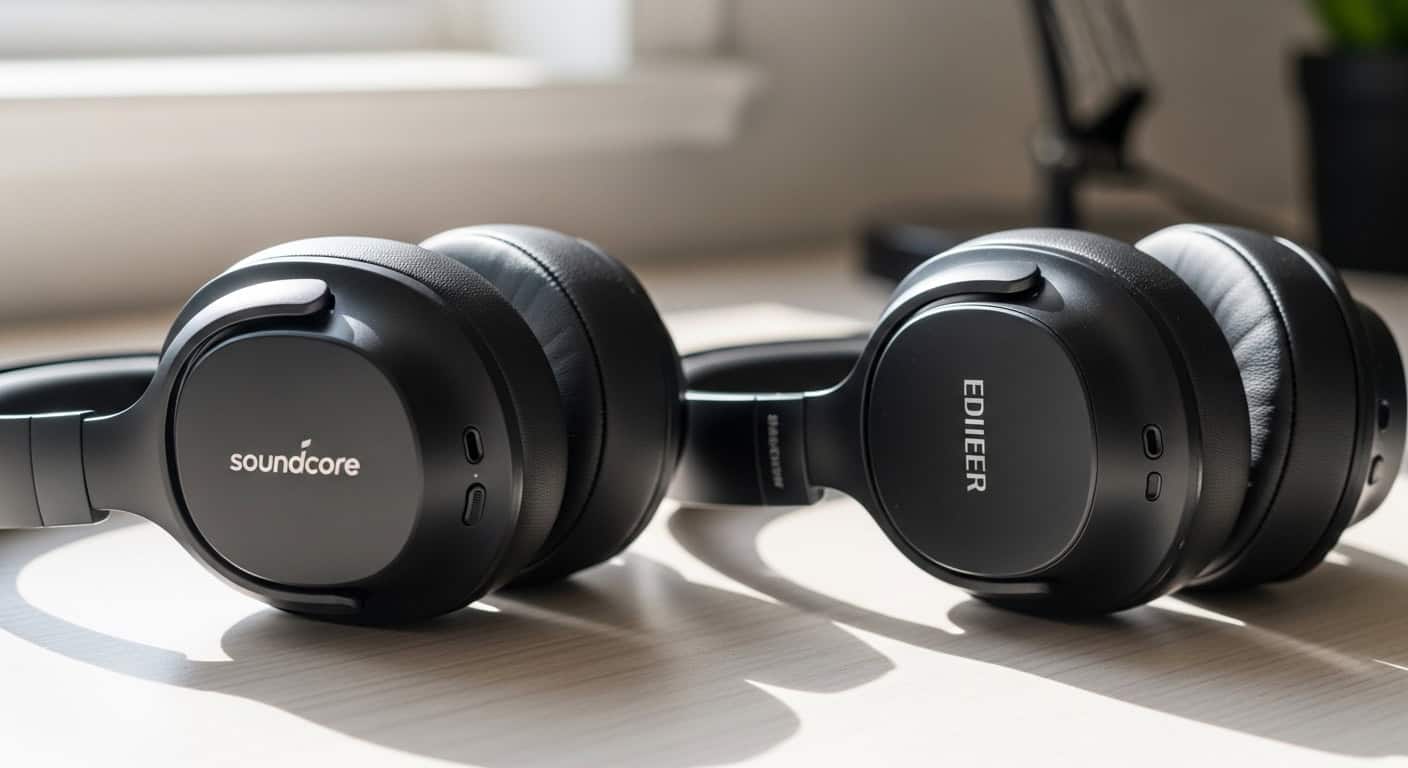
Comfort is almost always a deciding factor for daily wear. You need to consider clamp force, ear pad depth, and whether the headphones will hold up to travel.
The Life Q30 has comfortable pads and a relatively secure clamp. For many people, the Q30’s fit works well for longer listening sessions, though if you have a smaller head, you might notice slightly higher clamp force at first. The ear pad depth is adequate for casual listening, but people with longer ears might feel a touch of contact with the driver housing over long sessions.
The Edifier W820NB Plus Gen 2 tends to be lighter with a lower clamp force. If you prioritize all-day wearability or plan to use the headphones for long work calls, the Edifier is often the more comfortable option for extended use. The pads are soft, and the ear cup profile is a touch shallower, which reduces heat and pressure over time.
Both models use mostly plastic construction to keep costs down. That isn’t a deal-breaker; in 2026, you can reasonably expect both to survive years of careful use. The hinge and joint quality on the Edifier has been refined in Gen 2, which makes the folding mechanism feel less creaky and more travel-ready. The Q30 is sturdy enough but feels slightly bulkier in a bag.
Clamp force
The Q30’s clamp gives a reassuring seal that helps ANC performance, while the Edifier’s gentler clamp favors comfort. If you prefer a snug fit for better passive isolation, the Q30 will be more your pace. If you favor comfort during long sessions, the Edifier will likely be easier to forget you’re wearing.
Ear pad depth
Both models provide reasonable pad depth for most ears. If you have particularly long ears, expect slightly more contact on the Q30. The Edifier’s lighter profile reduces this potential issue.
Long-session comfort
If you work long shifts or have long flights, the Edifier edges out due to its lighter weight and lower clamp force. The Q30 remains competitive and is comfortable for many users, but you may notice fatigue sooner if you’re sensitive to clamping pressure.
Travel durability
Both fold for travel and fit into soft cases. The Gen 2 Edifier feels a bit more refined at hinges, and the Q30’s slightly bulkier design occupies more luggage space. Neither is fragile, but you’ll want a protective case for both if you carry them in a packed bag.
Battery Life and Charging
Battery expectations are a big part of the buying decision for budget ANC headphones, since long battery life is one of the things these models do well compared with some pricier alternatives.
Real-world battery life with ANC on depends on volume and codec use, but you can expect lengthy runtimes from both. The Soundcore Life Q30 commonly delivers in the mid to high 30-hour range with ANC on during mixed use, and much longer with ANC off. The Edifier W820NB Plus Gen 2 tends to push a bit farther under similar conditions, often reaching the 40–50 hour range with ANC on in many user reports.
Fast charging is useful for the forgetful or those who need a quick top-up before a trip. Both models offer fast-charge capability that delivers several hours of playback after a short charge. That feature reduces the pain of forgetting to charge overnight and makes these headphones more practical for travel and daily life.
Both headphones use USB-C for charging, which is now a standard convenience you can expect in 2026. That means you can share chargers and power banks with most modern devices without juggling adapters.
Realistic ANC-on battery performance
Under real-world listening levels, the Q30 and Edifier will both give you multiple days of typical use on a single charge. Expect to charge less frequently than you would with many true wireless earbuds. If long battery endurance is a priority for you, both models will satisfy, with the Edifier often lasting a bit longer under similar listening conditions.
Fast charging usefulness
A short charge before you head out will often give you enough playback for a commute or a meeting. Fast charge isn’t unique to these models, but the implementation is practical and reliable in day-to-day use. You shouldn’t have to plan charging meticulously with either pair.
USB-C standard mention
Charging over USB-C is a practical convenience. In 2026, most of your devices will likely use USB-C as well, so cable compatibility is unlikely to be an issue.
Bluetooth, App Experience, and Features
Connectivity and software shape how convenient the headphones are when you actually use them across phones, laptops, and tablets.
Both models support the common Bluetooth stacks and offer app-based customization. Expect SBC and AAC support across most devices; don’t count on consistently available high-resolution Bluetooth codecs like LDAC or aptX across all devices and regions. In practice, AAC offers decent performance on most phones, and SBC remains functional where AAC isn’t available.
Multipoint connectivity is one area where implementation varies. The Edifier W820NB Plus Gen 2’s multipoint has been generally more stable after Gen 2 refinements; you can switch reliably between a phone and laptop in many real-world setups. The Q30 offers multipoint as well, but you may encounter device-switching quirks depending on firmware and device combinations.
App stability matters because updates and EQ adjustments will shape your long-term experience. The Soundcore app is feature-rich and tends to be stable; it receives periodic firmware updates and sometimes introduces useful improvements. Edifier’s Connect app is simpler and more stable; firmware updates are less frequent but practical when they do arrive.
Multipoint reliability
If you regularly switch between two sources, look closely at each model’s multipoint behavior with your device ecosystem. Edifier’s implementation in Gen 2 is typically less frustrating, while Q30 multipoint works but can be finicky with certain phone+PC combos.
Codec support (keep claims conservative)
Both headphones support the baseline codecs you’ll encounter. Don’t buy either expecting high-res Bluetooth codec performance. Instead, accept that everything will sound good enough for streaming and calls, and rely on EQ when you want to tweak tonality.
App stability and firmware updates
Soundcore’s active app development and EQ depth are advantages if you enjoy tweaking sound. Edifier’s app is more utilitarian but reliable. Firmware updates can improve ANC and connectivity, so check for updates after you buy.
Call Quality and Microphones
Microphone performance matters if you’ll use headphones for work calls, remote meetings, or frequent voice chats. You’ll want to understand where these cans shine and where they fall short.
In quiet rooms, both the Q30 and the Edifier produce intelligible, pleasant-sounding voices. They do a competent job for casual calls, and you can expect clear speech pickup in one-on-one conversations with minimal background noise.
Noisy or windy environments are where budget headsets struggle. Both models reduce ambient noise to an extent, but microphone systems on budget ANC headphones have limits. In windy streets, bus windows, or crowded stations, call clarity degrades, and wind noise can mask your voice. Neither will outperform a dedicated wired headset with directional mics, so manage expectations.
For work calls, both are suitable for most remote meetings in quiet indoor settings. If you require studio-quality voice clarity or plan to take calls in noisy outdoor environments often, consider a dedicated headset or an external microphone.
Quiet environment performance
Inside a quiet office or at home, both will serve you well for video meetings and phone calls. Microphone pickup is natural and sufficient for typical business use.
Noisy/windy environment limitations
Outdoors and in windy conditions, expect performance to drop significantly. Neither model will reliably remove wind interference, and both can produce muffled or clipped audio in very loud settings.
Suitability for work calls
For standard remote work and casual calls, both are fine. If you regularly handle calls in noisy public spaces, you may want a different solution tailored to that need.
How Most Buyers End Up Choosing
In practice, the decision usually comes down to whether you prefer stronger bass impact and deeper EQ control, or a more relaxed, balanced sound with easier long-term wear.
There isn’t a universally superior model — there is only the one that fits your listening habits better.
Which One Should You Buy?
Use the points below to decide based on how you plan to use the headphones.
Choose Soundcore Life Q30 if…
- You want a punchy, bass-forward sound for EDM, hip-hop, or modern pop, and you plan to tune the sound further with a flexible EQ.
- You prioritize stronger low-frequency ANC for flights and long sessions of steady hum reduction.
- App-based customization (10-band EQ, presets) and frequent firmware updates matter to you.
- You value a slightly more secure fit and don’t mind a bit more clamp for better passive isolation.
For the complete breakdown, see our full Soundcore Life Q30 review.
Choose Edifier W820NB Plus Gen 2 if…
- You prefer a balanced sound with clearer mids for vocals, podcasts, and mixed music libraries.
- Comfort for long wear and a lighter clamp force are high priorities for you.
- You want multipoint connectivity to be reliable across phone and laptop without frequent re-pairing.
- You favor natural-sounding ambient mode and a slightly more refined build for travel.
You can read the in-depth analysis in our Edifier W820NB Plus Gen 2 review.
These bullet points should help you match the practical strengths of each model to your priorities. Don’t choose based solely on specs; consider how you’ll use the headphones day to day.
Affiliate disclosure: This article may contain affiliate links. If you purchase through them, we may earn a small commission at no extra cost to you.
Where to Buy and Check Current Prices
Retail pricing, bundles, and availability can change frequently. Comparing reputable retailers can help you understand which model currently offers the stronger value.
Quick Recommendation by Buyer Type
If you want heavier bass and stronger low-frequency noise reduction for flights or constant rumble, the Soundcore Life Q30 is usually the better match.
If you prioritize comfort for long days, clearer vocals for calls and podcasts, and more dependable device switching, the Edifier W820NB Plus Gen 2 often feels easier to live with.
For buyers who enjoy adjusting EQ and tailoring sound signatures, Soundcore’s app provides more flexibility. For those who prefer a simpler, set-and-forget approach, Edifier’s streamlined controls may be preferable.
Why Both Are Popular
Both headphones succeed because they balance price, features, and reliability in ways that suit the majority of listeners. Rather than chasing perfection, they focus on delivering strong everyday usability, which explains their continued popularity in 2026.
Conclusion
The better headphone is the one that disappears on your head and fits naturally into your daily routine. Small usability differences will influence your satisfaction far more than minor variations in specifications.
Both the Soundcore Life Q30 and the Edifier W820NB Plus (Gen 2) remain strong, pragmatic choices for budget ANC headphones in 2026. Neither will replace a premium headset if you demand the last word in noise cancellation or studio-grade call quality. Still, each offers a compelling mix of features for its price: the Q30 brings impactful bass and rich app customization, while the Edifier prioritizes balanced sound, comfort, and dependable multipoint behavior.
Choose based on your use case: pick the Q30 for stronger ANC and more aggressive, fun sound; pick the Edifier if comfort, vocal clarity, and natural ambient modes matter most. Either way, you’ll get far more listening time and useful features than older budget options once did.
If you’re still undecided, revisiting the full Soundcore Life Q30 review and the Edifier W820NB Plus Gen 2 review can help confirm which sound signature and comfort profile fit you best.
Last updated: February 2026.
We review specifications, firmware notes, and user feedback regularly to keep comparisons accurate.
About the Author
Ren Ariola is a product reviewer and researcher focused on budget-friendly audio and practical technology. He tests everyday-use scenarios such as commuting, remote work, and long listening sessions to translate technical features into real-world buying advice.
His reviews emphasize comfort, durability, and long-term value rather than marketing claims.